Why Apple's Health AI Study Starts With Trust, Not Right Answers
Apple and OpenEvidence will enroll up to 200,000 US adults to study how people understand, trust and use AI health information. The announcement is a study launch, not a diagnostic product.

The 20-second read
1. In health AI, is trust more important than the right answer?
Asking an AI a health question is becoming routine. What does a symptom mean? How should a test result be read? What is worth knowing before a doctor's visit? AI that explains complex medical information in plain language is already drawing wide interest.
In health, though, an accurate answer is not enough. It also matters whether the user understood it, how far they trusted it, and what they did as a result. The same explanation can push one person to see a doctor and give another a reason to put off a professional's judgment.
That is the point Apple is probing in this study. It looks not only at what the AI says, but at how people take the answer in.
The core point: health AI's performance does not end in the answer window. It creates value only when it carries through to the user's understanding and behavior.
2. Up to 200,000 people: Apple is watching how people respond
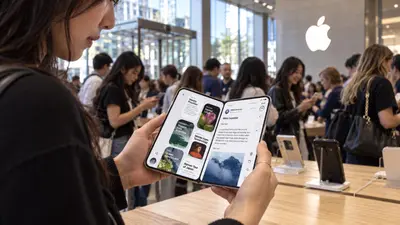
On November 15, 2026, Apple announced that it is launching the Apple Health AI Usage Study with OpenEvidence. The study is open to eligible participants in the United States who are 21 or older, and recruitment is capped at 200,000. Applicants need an iPhone 15 Pro or later that supports Apple Intelligence, running iOS 26 or higher, and must sign up through a separate research app.
The study's questions fall into three groups. How accurately do people understand the health information AI gives them? How much do they trust it? And how do they use it in daily life?
The three are linked. If people do not understand the information, even an accurate answer is worth less. If they trust it too much without fully understanding it, that can lead to risky decisions. The concern covers not only cases where AI gets something wrong, but also cases where a correct answer is taken as a definitive diagnosis of one's own situation.
Apple is trying to measure more than an AI's answer score. It is measuring how answers enter a person's decision process. The announcement is a study launch. It does not mean a diagnostic service is coming or that efficacy has been shown.
3. The hard problem in medical AI sits between "explaining" and "interpreting"
Medical information mixes technical terms, statistics and individual differences. When AI turns difficult material into simple sentences, access improves. But explaining something simply is not the same as making sure it is understood correctly.
A user who reads general health information may take it as a conclusion about their own symptoms. A sentence describing a possibility can be misread as a firm judgment. Even when the wording is right, the outcome changes if the user misses the context.
For that reason, health AI needs two abilities together. One is providing medically reliable information. The other is helping users understand the scope and limits of that information, including when it is fine to rely on it and when a clinician's judgment is needed.
The test of success for health AI could widen from "how convincingly does it answer" to "does it help people use the answer safely and beneficially."
In health AI, an easy explanation is the starting point. What matters is whether it leads to correct understanding and action.
4. Apple's strength is everyday touchpoints, not a single model
The way Apple enters this race is interesting. Through the iPhone, Apple Watch and the Health app, it already sits where people's daily lives meet their health data. It can combine that with software experience and brand trust on privacy.
In this structure, AI is likely to function less as a standalone answer service and more as a feature inside the existing ecosystem that helps people understand and use health information. A user checks health information on a device they already use, grasps the needed context and prepares a next step.
This matters for AI industry competition too. So far the market has focused on bigger models, higher benchmark scores and faster inference. But in services people use every day, access, user experience, trust and data management also shape the choice, beyond model performance.
Apple's assets ease the burden of solving everything with its own model. It can connect devices, the operating system and service experience to design how users meet AI. The partnership reads as an effort to test that possibility by combining medical AI technology with Apple's user experience.
AI platform strength comes not only from the model itself but also from who designs the environment in which users meet it.
5. Investors should watch the path to business, not the results
From a long-term investing view, it is too early to count this announcement as a new revenue source. What matters more is what direction the study gives Apple's health services strategy, and whether it turns into real products and services.
First, watch whether the study leads to a formal launch of health AI features. If findings on how participants understand and use AI feed into product design, Apple could gain a base for expanding health AI in a more careful and realistic way.
Second, regulation and liability. Errors in health information cost more than errors in ordinary search or recommendations. The range of information a service offers, the division of roles with clinicians, and design that keeps users from misunderstanding will be conditions for expansion. Trust is not secured by brand image alone. It has to be shown repeatedly in actual use.
Third, usage and the revenue model. Many people showing interest is different from sustained use. The economic meaning depends on whether health features work as ecosystem value that supports device upgrades and service use, or grow into a separate paid service.
Fourth, the effect on the Apple ecosystem. If health AI increases everyday device use and raises the importance of the Health app, it could help retain customers across devices and services, beyond any direct AI revenue.
What investors should check is not the buzz around the study but the path by which trust converts into repeat use and ecosystem value.
6. One principle for using AI health information wisely
What individual users need is not complicated: treat an AI answer not as a final verdict but as a starting point for asking better questions.
If AI unpacks an unfamiliar medical term or explains a phrase in a test result, it can lower the barrier to understanding. But general explanations should not be taken as firm conclusions about one's own symptoms. A more sensible approach is to use what the AI says to organize questions and confirm important decisions with a clinician.
Apple's study shows that as health AI enters people's lives, the design of trust matters as much as technical accuracy. The more easily AI explains, the more users may understand. At the same time, the smoother the explanation, the greater the chance people trust it more than they should.
The next stage of AI competition probably will not end with building smarter answers. Companies that design how far people can trust those answers, and how to use them, may hold an edge. That is the problem Apple is looking at first, in the sensitive field of health.
The question that remains: the more easily AI explains, will we understand our health better, or trust the AI more than we should?
- It is a study Apple announced on November 15, 2026, saying it will begin it in partnership with OpenEvidence.
- It examines how well people understand, trust and use the health information AI gives them.
- Eligible participants must be 21 or older and live in the United States. Enrollment is up to 200,000 people.
- They need an iPhone 15 Pro or later that supports Apple Intelligence, running iOS 26 or higher.
- Sign-up is through a separate research app.
- In health, a correct answer may not be enough.
- Even accurate information can lead to risky decisions if users take it as their own diagnosis.
- This is the article's analysis, not a reason Apple itself has given.
- No. The announcement is the start of a study.
- It does not mean a diagnostic service is launching or that effectiveness has been proven.
- It is reasonable to use it as a starting point for preparing better questions, not as a final verdict.
- Confirming important decisions with medical professionals is arguably the better approach.
What to watch
Insight Times Editorial Desk