How Far Can AI Evolve? Physics Sketches Intelligence From 5 to 10,000 Years Out
Scaling laws opened the age of AI. But the speed of light, waste heat, energy and human choices could steer growth in very different directions.
The 20-second read
How far can we trust the intelligence growth curve?
A 2020 study of AI scaling showed that as model size, data and training compute grow, a language model's prediction loss falls along a consistent empirical rule. The key point is that this does not prove intelligence rises linearly without limit.
By Epoch AI's tally, training compute for frontier language models has grown roughly fivefold a year since 2020, by estimate. The growth of compute supplied by AI chips is a separate metric. Blending growth rates from different metrics into one forecast easily produces exaggeration.
The Epoch Capabilities Index (ECI) combines several AI benchmarks into one performance measure. It is not a human IQ score. Figures such as "60 IQ points for every tenfold increase in compute" or "an AI with an IQ of 1,200" rest on no verified conversion formula, so they cannot serve as a yardstick for future capability.
Act 1 | The next 5 to 10 years: execution matters more than raw intelligence
Around 2031, AI could compete with, or surpass, top experts across a large share of scientific research and software development. But there is no agreed forecast for when an AGI that performs every field autonomously might arrive. Lab automation, error verification and robotic physical manipulation would all have to advance together.
The key variable around 2036 is not whether AI has surpassed the combined compute of all human brains. It is the rate at which AI converts the computation it gains into real productivity and scientific discovery. The computational capacity of a biological brain is poorly defined, so comparing it directly with AI FLOPS is difficult.
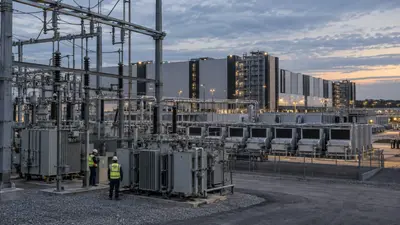
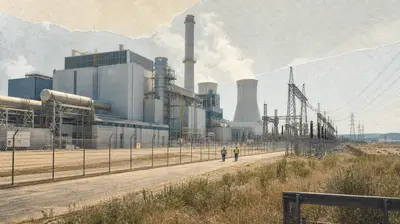
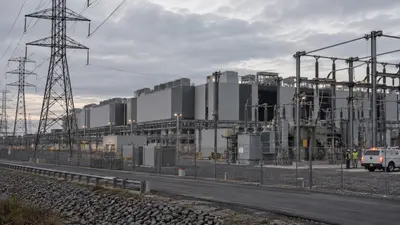
Power is a strong constraint, but the claim that "the whole Earth runs short of electricity in 2035 and escapes to space" is not a confirmed outlook. Grid expansion, chip efficiency gains, demand management, liquid cooling and dedicated power sources will likely compete first.
Act 2 | 50 to 100 years: between the Sun's energy and the speed of light
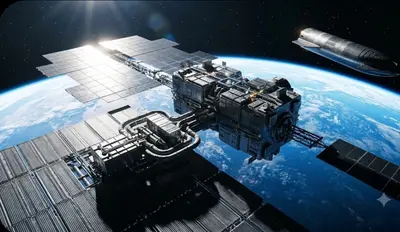
A Dyson swarm in the 2070s to 2120s is a hypothetical concept: countless independent structures collecting starlight. The Sun's luminosity is about 3.828×10²⁶ W. Even harvesting a tiny fraction of that would allow computation on a scale different from today's ground-based data centers. Whether space mining, precision manufacturing, orbital maintenance and space transport could keep pace is unknown.
The speed of light sets an absolute floor on communication delay. For a task in which distributed nodes must exchange a signal once, the minimum round-trip delay in a system of diameter d is t ≥ 2d/c. Not every thought needs a round trip across the whole structure, though. If regional AIs compute independently and exchange only results, a vast intelligence network can still work well.
Waste heat is also a practical problem. Landauer's principle says the minimum energy needed to logically erase information is k_B T ln2. That does not mean every computational step must produce this much heat. Reversible computing is theoretically possible, but a real facility's power ultimately demands thermal management and heat-rejection design.
One important correction is needed. A Dyson structure radiating energy as infrared does not raise the entire cosmic background temperature from 3 K to 300 K. Nor does the calculation that Earth's oceans boil in exactly three years hold up. The effect on Earth must be computed from the structure's position, shading, radiation direction and the net energy Earth receives. Moving to Neptune's orbit is not the only solution either.
The price list physics sets for communication delay
Taking the speed of light as about 300,000 km/s and computing a simple round trip, the allowable diameter is about 150 km at 1 millisecond, about 30,000 km at 0.2 seconds, about 9 million km at 1 minute, and about 540 million km at 1 hour. This does not mean an AI of that size reaches a particular IQ. It is a floor on communication delay.
Taking the average Sun-to-Neptune distance as about 30 AU, a one-way signal takes about 4.2 hours. A one-way trip across the diameter takes about 8.3 hours, and a round trip along that path about 16.7 hours. Again, this applies to a centralized task that must cross Neptune's entire orbit once and back. It does not mean every AI's thinking cycle becomes 17 hours.
| Delay | Diameter |
|---|---|
| 0.2 seconds | about 30,000 km |
| 1 minute | about 9 million km |
| 1 hour | about 540 million km |
Act 3 | 500 to 1,000 years: many intelligences, not one superintelligence
Imagine the future around 2526 to 3026. If autonomous manufacturing and interstellar travel become possible, self-replicating probes could build equipment and harvest energy in new star systems. But probes that travel at 10 to 20% of light speed or replicate themselves are not technology realized today.
Even to the nearest star, Proxima Centauri, light takes about 4.2 years one way. A vast interstellar network may look less like a single real-time central government and more like a federation that judges locally and exchanges knowledge with a lag. Whether humans take part as protected ancestors or in modified form is a question of social choice more than technology.
Act 4 | 5,000 to 10,000 years: thinking longer, not faster
Predicting the technology of the years 7026 to 12026 is effectively impossible. Still, as long as computation happens in physical devices, the constraints of energy, communication and entropy do not disappear. Ideas such as cryogenic computing or extracting energy from a rotating black hole can be studied in physics, but they are far from realization at civilizational scale.
The 2017 "aestivation" hypothesis from Anders Sandberg and colleagues holds that waiting for the lower background temperature of the far future would let a civilization process more information from a given amount of energy. It remains a hypothesis, and results vary with cosmic expansion, available energy and the method of computation.
In the end, the question shifts from when AI stops to how it evolves. Evolution by growing larger, by improving algorithms, by distributing and cooperating, and by conserving energy to last longer could compete with one another.
- No. Even if the amount of work beyond expert level grows, the definition of AGI and the standards for verifying it are themselves disputed.
- No. It would need autonomous robots, economic viability, space infrastructure, and a reason to pursue such a goal.
- No. Earth's energy balance depends on where the structures are placed, how they block sunlight, and the direction in which they radiate waste heat.
- We can't conclude that it is impossible. Real-time synchronization would slow down, but distributed computing and asynchronous cooperation are possible.
- It is to develop rules on responsibility, control, energy, and distribution alongside, and separately from, the race over AI performance.
What to watch
Insight Times Editorial Desk