Memory Earnings Are Still Rising. The Money Is Already Leaving.
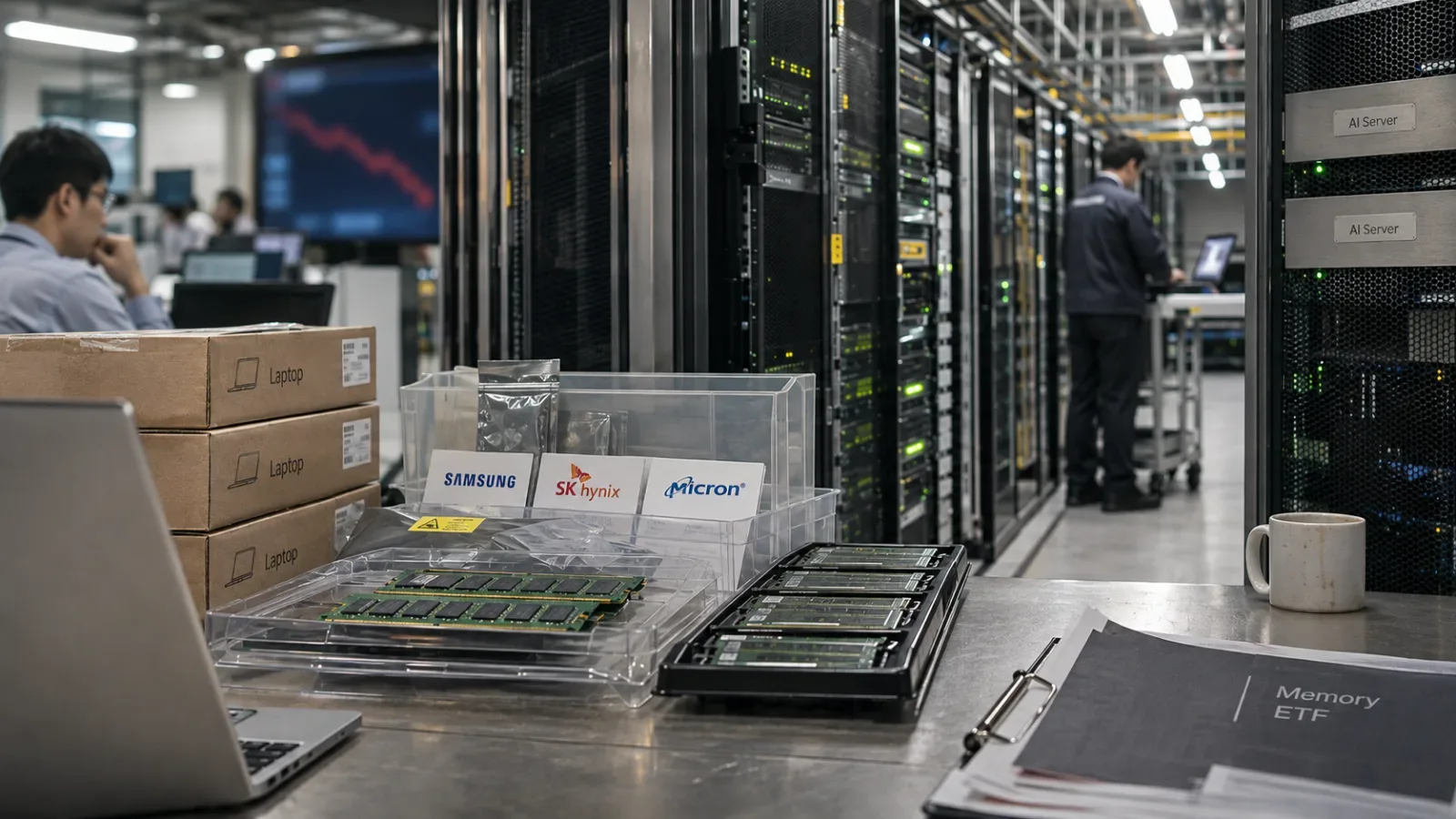
DRAM ETFs have seen 12 straight weeks of outflows while prices still climb. PC makers are cutting orders, and AI server customers are still locking in supply.
The 20-second read
Memory chip earnings are improving. Prices are still rising. So why is investor money leaving first?
Last Sunday's check (11/8) looked for signs that the memory shortage is easing in intensity. This week brought a more concrete change. PC makers have begun cutting actual order plans. AI server customers, meanwhile, still want to secure supply. The memory market is not cooling all at once. Different parts are moving at different speeds.
1. Why is money leaving while earnings rise?
DRAM ETFs tracked by Global Markets Investor have seen 12 straight weeks of outflows. Cumulative outflows total $5.7 billion. Memory makers are selling at high prices and lifting earnings expectations, yet investors are pulling money from related assets.
Markets do not look only at how much a company earns today. They first ask whether profits will keep growing, and whether now is the best stretch. That is why shares can weaken even as earnings forecasts are revised up.
This week's flows show that time gap. Outflows alone cannot confirm an industry peak. But if buying weakens even as results improve, it is reasonable to read that as the market starting to doubt future profits.
First signal this week: Earnings describe the present. Fund flows worry about what comes next.
2. Why are PC makers cutting orders?
The biggest change this week is the inventory and order adjustment among PC makers confirmed by TrendForce on 11/11 (Wed). Manufacturers that bought memory in advance in the first half began running down stockpiles as finished-product sales slowed. Some also lowered next year's memory purchase plans.
The logic is simple. As memory prices keep rising, PC makers must raise prices or cut specs. If consumers will not absorb the cost, sales fall and manufacturers order less memory. Third-quarter notebook shipments fell 15.8% from the previous quarter.
Pricing is shifting too. PC DRAM is still expected to rise, but by less than in earlier quarters, and the outlook for consumer SSD increases is under 5%. That does not mean prices have collapsed. It means some customers are finding it harder to accept higher prices.
Last week, buyers in the consumer memory spot market were merely sitting on the sidelines. This week, manufacturers' procurement plans changed. The warning has moved into actual orders.
Second signal this week: Cracks in the memory boom are showing up first in customers' smaller orders, not in falling prices.
3. Why is the AI server side still firm?
PC order cuts do not cool the whole memory market. AI server and cloud companies still want to lock in the volume they need. SK hynix has secured long-term supply contracts covering more than half of its 2027-2028 production capacity. TrendForce expects price increases for enterprise server SSDs to strengthen, unlike consumer SSDs.
The time it takes for supply to grow also matters. Micron expects about $25 billion in capital spending in the first half of fiscal 2027. But much of that money goes not to equipment that lifts output right away, but to building out factory space for later use.
A decision to invest today does not flood the market with memory tomorrow. The real supply increase comes later. So even if PC demand weakens, tightness in server memory could last for some time.
Still, long-term contracts do not guarantee prices to the end. What matters going forward is less the size of contract announcements than whether customers keep taking delivery.
Third signal this week: Consumer and AI server memory are the same chips, but they sit in different economic cycles.
4. Is Wall Street worried about now, or about 2028?
Wall Street's question has changed too. The debate now centers less on whether memory makers are earning well today than on whether those high profits can hold in 2028.
In a November report, Morgan Stanley's Shawn Kim cut his SK hynix price target by 38% and his Samsung Electronics target by 19%. Notably, he raised near-term earnings forecasts. The cut reflects not weaker profits now, but the chance that margins fall once new fabs start up and supply grows.
Not everyone on Wall Street agrees. Nomura maintains its view that the memory market will stay tight through 2028. Goldman Sachs said Micron's risk-reward has improved but kept a neutral rating, and saw its Korean rivals as relatively more attractive.
The difference matters. 2028 is not a year of downturn already decided. It is the point where the pace at which new fabs turn into output meets the pace at which AI demand grows. If supply grows faster, profits could roll over. If customer demand keeps outrunning it, the boom could last longer.
Fourth signal this week: Wall Street is starting to ask how much profit will remain in the next capacity-expansion cycle, not how strong current results are.
5. How should long-term investors read memory this week?
The verdict this week is clear. The memory chip peak is one step closer than last week. That is two straight weeks of signals pointing the same way. But the peak is not confirmed.
Splitting the peak into three makes it less confusing. The peak in price growth looks more likely to have passed. In consumer products, prices are rising, but more slowly.
The peak in corporate earnings may not have arrived yet. Still, Morgan Stanley's specific case for lower 2028 profits has sharpened the timeline of the debate. The peak in share prices, meanwhile, is drawing warnings from flows, which move ahead of earnings.
Next week, three changes are worth following: whether PC inventory adjustments spread to order cuts by server customers; whether actual DRAM and NAND transaction prices move from slower increases to declines; and whether AI memory customers keep taking the volumes they committed to. Nvidia-related announcements on 11/17 (Tue) need only be read through one lens, the continuity of memory customer orders.
For long-term investors, what matters is not whether shares rose or fell this week. It is who is cutting orders, who is still buying, and how far the stock market is moving ahead of those changes. Those three need to be told apart now. The memory boom is not over. But the order in which it ends is already beginning to show.
- The market is probably asking first whether profits will grow further from here, rather than looking at current earnings.
- According to Global Markets Investor, DRAM ETFs have seen outflows for 12 straight weeks, totaling $5.7 billion.
- However, outflows alone do not confirm that the industry cycle has peaked.
- Memory prices are rising, but consumers have not accepted the higher costs, and sales have slowed.
- Third-quarter notebook shipments fell 15.8% from the previous quarter.
- PC makers are working down inventory they bought ahead of time in the first half, and some have also lowered their purchase plans for next year.
- AI server and cloud companies are trying to secure the volume they need in advance.
- SK hynix has secured long-term supply contracts covering more than half of its 2027 to 2028 production capacity.
- Even with contracts, prices are not guaranteed to hold to the end. What matters is whether customers keep taking delivery of the volume.
- It appears to have priced in advance the possibility that margins fall once new fabs start operating and supply increases.
- Shawn Kim cut the SK hynix price target by 38% and the Samsung Electronics target by 19%.
- He actually raised his near-term earnings forecasts.
- That is not confirmed yet. Signs that the peak is near have grown, but nothing is settled.
- The evidence is stronger that the peak in the rate of price increases has passed.
- The peak in company profits may not have arrived yet. Nomura expects supply and demand to stay tight through 2028.
What to watch
Insight Times Editorial Desk