Nvidia Goes to German Factories, Betting AI's Next Market Is Robots and the Shop Floor

AI's growth is not confined to data centers. Germany's industrial data and digital twins show the opportunity, but investors still need to check real profitability.
Germany has something Nvidia does not yet have enough of: data. Decades of machine movements, production processes, quality control and engineering experience, accumulated on factory floors.

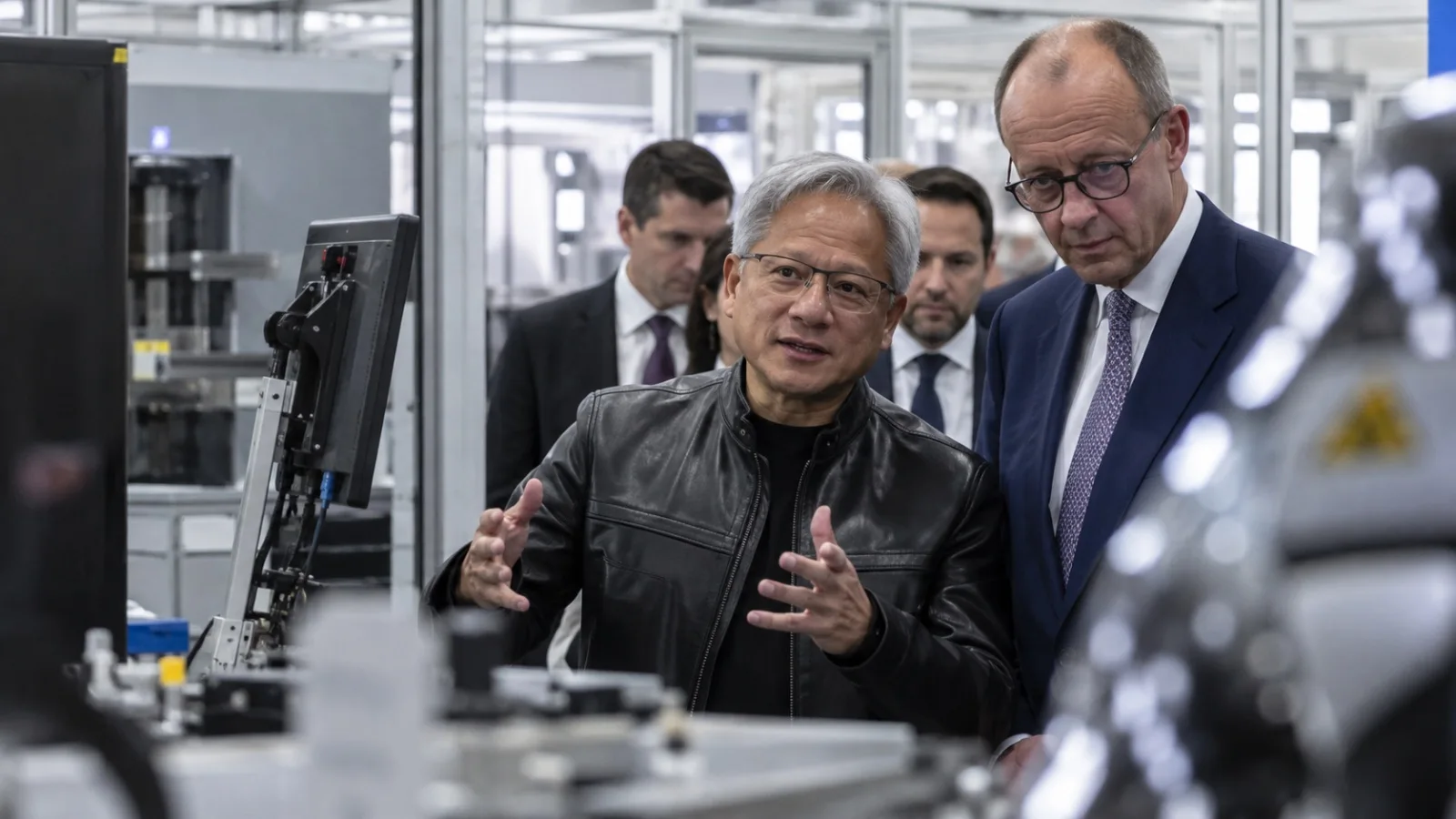
On Oct. 19 in Berlin, Nvidia CEO Jensen Huang met German Chancellor Friedrich Merz. Their talks point to where AI's next growth market may sit: autos and industrial machinery, factories and robots.

1. Why did Nvidia pick Germany?

Germany does not lead the world in giant AI models the way the United States does. But it has world-class companies and technology in autos, industrial machinery and precision manufacturing.

The key asset is not the factories themselves.

It is the vast body of industrial data: which machine should run at what speed, at what temperature defect rates climb, where the bottlenecks in a production line appear.

Generative AI advanced on text and images published on the internet. Physical AI has to understand the physical properties and control data of the real world. Even picking up an object requires a robot to calculate weight, friction, position and collision risk.

That kind of data and know-how is hard to scrape from the internet.

This is likely why Huang stressed German manufacturing. Future AI competitiveness may depend not only on chip performance but on who secures and uses better real-world data.

Nvidia signed a memorandum of understanding with the German government on industrial AI cooperation and announced plans to invest in four German startups.

CompanyMain business
Agile RobotsIndustrial robots and automation
Avelios MedicalMedical software
MireloAI audio technology
Reflex AerospaceSatellite manufacturing

The four span robotics, health care, audio and space. One reading is that Nvidia is interested less in a single manufacturing niche than in the whole ecosystem of industries where AI will be applied.

One caveat: the roughly $10 billion investment pledge for Europe's technology ecosystem is not the amount going into these four startups. It covers Europe as a whole. The letter of intent with the German government should also be kept separate from confirmed revenue.

2. What Siemens saw: up to 85% less workload

  • Engineering workload for virtual production setup: up to 85% lower (for preparing production of a specific PCB)
  • AI-agent production planning: up to 20% lower manufacturing cost (a possibility)

Figures released by Siemens based on its Erlangen plant. They do not mean total factory labor hours fell 85% or that manufacturing costs fell 20%.

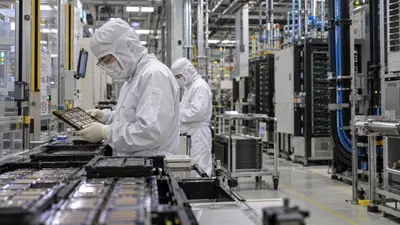
Siemens' electronics plant in Erlangen, Germany, shows the change in concrete terms.

Previously, producing a new printed circuit board (PCB) meant building a physical prototype first and then preparing the quality-inspection system. Now inspection AI can be trained in advance on virtual product images generated in a digital twin.

Siemens said that in a specific process it can cut engineering workload by up to 85% and time to market by up to 40%.

It also described the potential to cut costs by up to 20% by having AI agents analyze order volumes, materials and equipment utilization, propose production plans and verify them in a digital twin.

A digital twin is a virtual space that mirrors a real factory. Equipment layouts, work sequences and robot movements can be tested without stopping the line.

How industrial AI works

  1. Equipment and operating data from the real factory
  2. Virtual experiments and AI training in the digital twin
  3. Verified production plans applied to the real factory
  4. Productivity, quality and cost data fed back into training

The important point is that these numbers are results or expected benefits from specific cases Siemens disclosed. They are not averages across manufacturing, and they are not independently verified long-term results.

Still, they matter because AI's economic value is starting to be measured in factory workload and cost rather than abstract performance scores.

3. Who makes the money? Not only Nvidia

If the industrial AI market grows, new demand could flow to Nvidia.

Typical examples are the GPUs needed to train AI models and simulate factories, development tools such as Omniverse and Isaac, and Jetson-based robot computing.

But the core manufacturing data and customer relationships sit with industrial software companies such as Siemens. Suppliers of automation equipment, sensors and robots also play important roles.

CompanyIndustrial AI opportunityWhat investors should check
NVIDIA (NVDA)AI compute, simulation, robot computingActual growth in industrial revenue
Siemens (SIE)Factory automation, industrial data, digital twinsSoftware revenue and customer expansion
Rockwell Automation (ROK)US manufacturing automation and controlAutomation orders and margin improvement
Tesla (TSLA)Autonomous driving, Optimus humanoidReal productivity, manufacturing cost and commercialization

Tesla shows a different path for physical AI. Where Nvidia and Siemens supply technology and platforms to many manufacturers, Tesla is trying to commercialize self-driving and its own robots directly.

The economics differ. For platform providers, customer count matters. For robot makers, what matters is production volume, unit cost and actual hours in use.

Growth in physical AI does not mean every related company's earnings will rise at the same pace.

FAQ

AI's next growth market does not have to be a smarter chatbot.

Raising the productivity of existing factories, machines and cars by small increments could create considerable economic value.

Huang's German visit shows that possibility. But the final evidence investors should wait for is not a partnership announcement. It is improved profits at factories and real revenue at supplier companies.

How much money AI can earn in the real world is now the question that matters.

Nvidia's German push suggests the next stage for AI may be the factory, but whether it pays will show up in factory profits and supplier revenue.

Insight Times Editorial Desk
More by topic

Starting with this story's topics, then what readers are following now

Robotics

This story's topic13 storiesSee all →

Everything that makes machines do physical work.

Why Elon Musk's 4% Growth Call Deserves a Serious Read

Elon Musk says AI could double US GDP growth next year from roughly 2% to 4%. The number that matters isn't 4%, it's the idea that intelligence is turning from scarce labor into replicable capital.

Macro

Tesla's biggest asset is not the car: when Robotaxi and Optimus stop being options

Tesla's AI value sits in autonomy and humanoids, and both could dwarf car manufacturing. The gap is between a demo and a fleet that earns cash per vehicle.

Tech

After AI Gets Hands and Feet, the Bigger Shift Is in Classrooms, Not Factories

Physical AI is not a robotics buzzword. As AI moves off the screen and starts manipulating real objects, it is reshaping how factories compete, where the line between human and machine work sits, and the oldest question in education: what should we teach.

Tech

Humanoid Robots Sold Just 7,000 Units Worldwide Last Year

Videos of Tesla's Optimus, Unitree and Figure make the humanoid era look like it has already arrived. The real 2025 sales number tells a much smaller story.

Tech

A 2027 Playbook: Stop Watching the Business Cycle, Start Watching Where the Money Flows

A new Korean economics book, "The Reverse Flow of Money," argues that interest rates still act like gravity on every asset, but AI and chips are pulling in capital strong enough to defy it. For investors, the question is not the average growth rate but where that money goes, and where it eventually turns into cash flow.

Macro

AI Is Not One Wave. It Is Five, and They Do Not Peak Together

Treating AI as a single chip cycle hides the important part. Training, inference, infrastructure, agents and physical AI run on different clocks and different revenue models, which is why slower growth at Nvidia and the end of the AI supercycle are not the same sentence.

Investing

Musk's G20 message: AI's real bottleneck is not GPUs, it is electricity

A billion humanoids and a 20 to 30 percent bigger world economy make headlines. The line investors should read first is duller: AI chips are multiplying faster than the power and physical infrastructure needed to switch them on.

Tech

HBM

59 storiesSee all →

Memory stacked next to the GPU.

Has Memory Peaked? Prices Are Cooling, but the Shortage Looks Set to Run to 2028

Price growth has slowed and consumer demand is already breaking. Server and HBM supply remains short, and Micron says more than 75% of its 2027 volume is already committed to customers.

Tech

US AI Data Centers Are Headed for 90GW. Gigawatts Now Matter More Than Dollars

Goldman Sachs expects US data center capacity to grow from 64GW at the end of 2026 to 90GW at the end of 2027. The AI race is moving from buying GPUs to building power plants and transmission lines alongside them.

Tech

How Far Can China Push DRAM Without EUV

CXMT says it has shrunk DRAM features to 11.95nm using quadruple patterning instead of EUV lithography. The real question is not whether China caught up, but how much more it now costs China to get there.

Tech

AI Chip Peak Check: Demand Still Rising, Risk Building in 2027-2029 Supply and Funding

DRAM and NAND contract prices are still climbing and HBM suppliers hold the edge. Power shortages, AI financing costs and simultaneous memory expansion are the risks for later years.

Investing

Memory Chip Supercycle: Not at Peak Yet, But 5 of 6 Warning Signs Are Flashing

Memory prices are still climbing, but the pace is slowing and PC and smartphone demand is starting to crack under the weight of higher chip costs. This looks less like a price peak and more like a profit plateau building toward the next supply cycle.

Investing

2027 Isn't the End: Citi's Case for a Memory Supercycle Running to 2031

Citi says the memory shortage timeline is stretching again. If AI shifts from "train once" models to continual learning, HBM, server DRAM and enterprise SSDs could all fall short at the same time.

Tech

China's Memory Challenger Raises a Harder Question for the AI Boom: How Long Will Profits Last?

Samsung, SK hynix and Micron have more to watch than Chinese output alone. Wall Street's focus is moving to how long today's outsized profits can last.

Tech

A building that houses servers and networking gear and supplies them with powe…

Tesla Energy's 13.7GWh Paradox: Expectations Ran Faster Than Deployments

Q2 deployments recovered but margins collapsed. Q3 set a record for deployments and still missed estimates. The issue is not the size of AI power demand but how fast it converts into Tesla revenue and profit.

Tech

Why Nvidia Is Happy to Help Make AI Models Nearly Free

Falling model prices can squeeze model makers. For Nvidia, the number that matters is the total volume of tokens generated worldwide and the compute that produces them.

Tech

AI Needs to Find $1 Trillion a Year From Somewhere to Pay Back Its Capex

Saying AI capex is big is no longer the point. The harder question is what end users have to pay for the buildout to pencil out, and Goldman Sachs puts that number at roughly $1 trillion a year.

Tech

Nvidia Put $2 Billion Into Lumentum. Optics May Be the Next Bottleneck, but the Stock Has Already Run

Optical networking is emerging as the next constraint on AI data centers. Investors need to separate the industry's growth potential from the price they are already paying for it.

Tech

Why the White House Swapped "AI" for "Super Intelligence"

Executive Order 14434 renames AI across the federal government without defining a new technology. The real story is about roughly $700 billion in capex, free cash flow and electricity.

Tech

Nvidia's Next Target After GPUs: Controlling What AI Agents Are Allowed to Do

OpenShell and Sentry are not about policing what an AI says. They are about controlling, at the server infrastructure level, which files and APIs an AI can touch, what it can execute, and who can actually pull the plug when something goes wrong.

Tech

The AI Correction Is Not a Buy-the-Dip Signal. It's a Profitability Screen

As AI stocks wobble, the question isn't whether the theme survives. It's where bottlenecks still convert into real orders, pricing power and yield. Memory is at the center of that question right now.

Tech

NVDA

71 storiesSee all →

China Is Now Copying Something Harder Than Nvidia's GPUs: CUDA

DeepSeek and Huawei have open-sourced compute, communication and programming tools for Ascend. The contest with Nvidia is moving beyond chip speed to how easily developers can switch.

Tech

AI Has Five Years to Find $4.2 Trillion in New Annual Revenue

The AI infrastructure question is no longer how many more GPUs to buy. It is how quickly the trillions already committed can produce enough cash flow.

Tech

AI's Next Bottleneck Is Money, Not Chips

Broadcom is lending Anthropic up to $42 billion, and Nvidia wants to build a $500 billion market for loans backed by GPUs. The AI race may turn on what rate buyers pay to borrow.

Tech

Nvidia's $500 Billion Experiment: Wall Street Asks Who Backs the GPU, Not Just the Chip

The real issue in Nvidia's financing platform is not chip sales. It is how far Wall Street will trust GPU resale prices and rental income three to four years out.

Tech

Jobs Cooled, Yields Rose, and Only Chip Equipment Stocks Rallied

The S&P 500 slipped 0.17% on Sept. 29 while SOXX gained 1.19%. Investors did not abandon AI. They appear to be picking the AI names that can live with high rates.

Tech

Samsung's HBM4 Yield Hits 80% - Now the Real Fight Is Production Volume

Reports confirm Samsung's HBM4 yield has climbed to roughly 80 percent, but the bigger number is capacity: HBM wafer input is projected to jump nearly 40 percent next year, from about 180,000 to 250,000 wafers a month.

Tech

The US-China Summit Didn't Erase Taiwan Risk for Chip Stocks

Washington's Taiwan policy held, but roughly $14 billion in arms sales is still on hold. For AI chip investors, the summit reads less like risk removed and more like a fragile balance extended.

Macro