AI Cracked a 100-Year Math Problem. Why Is Weather Still Hard to Predict?
OpenAI says it found conditions under which the Navier-Stokes equations break down, and released 722 manuscripts with computer-checked proofs. What it solved is a specific counterexample, not turbulence in general.
1. A century-old secret in a glass of water
Drop a bit of milk into coffee. It first spreads like a white thread, then forms complicated swirls when you stir it with a spoon.
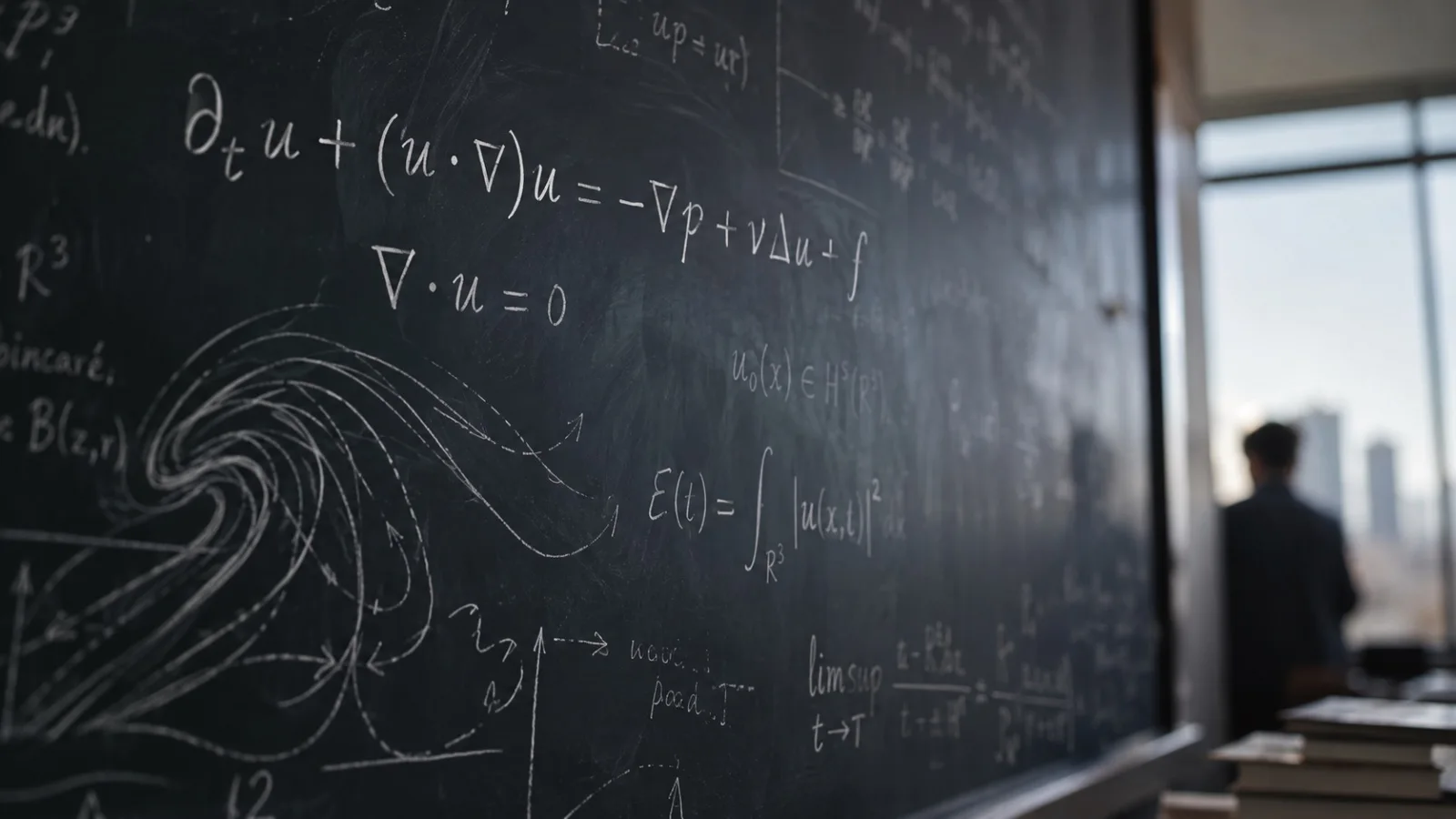
The formula that describes this motion is the Navier-Stokes equations. Despite the intimidating name, the starting point is Newton's law of motion from middle school science, F = ma.
Three kinds of forces move water and air. Pressure pushes, viscosity smooths the motion, and outside forces such as gravity change the flow.
The trouble is that water changes its own motion. Push water forward and the water beside it moves. That motion creates a vortex, and the vortex feeds back on the original flow.
Mathematicians call this nonlinearity.
The equations were written in the 19th century. Whether their solutions stay smooth forever in three dimensions has gone unproven for a very long time.
2. What mathematicians actually feared
In 2000, the Clay Mathematics Institute made this problem one of its seven Millennium Prize Problems, with a $1 million prize.
The core question is strikingly simple.
Can water that starts out flowing smoothly, inside the equations, move infinitely fast at some moment?
Mathematicians call this a singularity, or blow-up.
It does not mean real water moves at infinite speed. It means the continuum model the equations use to describe reality may stop being valid.
A mathematical blow-up is also different from a computer error. A simulation that stops does not prove a singularity.
3. The spaghetti vortex the AI found
On September 8, 2026, OpenAI released a proof that constructs a special fluid motion, along with a formal proof in Lean.
It starts with a fluid at rest. A mathematically very smooth external force is applied.
The vortex then curls toward the center and grows thinner and longer, like stretching a strand of spaghetti.
Velocity in one region grows without bound, yet total kinetic energy stays finite, because the fast-moving region narrows at the same time.
The key is that the singularity arises without forcing in an infinite external push. Motion, pressure and viscosity inside the equations balance in just the right way to produce it.
4. Is the Millennium Problem really solved?
There is an important distinction.
The Clay Institute's official problem recognizes two kinds of routes. Routes A and B prove that a fluid with no external force stays smooth forever. Routes C and D give a counterexample in which a singularity forms when a smooth external force is allowed.
C and D also differ not just in the type of force but in setting: infinite three-dimensional space and periodic three-dimensional space, respectively.
| Route | What is to be proved | OpenAI result |
|---|---|---|
| A / B | Global smoothness for all smooth initial conditions with no external force | Not addressed directly |
| C / D | A singularity counterexample allowing a smooth external force | Announced as solved |
Summary of the alternative proof routes in the Clay Mathematics Institute's official problem.
On September 11, the Clay Institute said the problem appears to have been solved. That carries far more weight than a company's own promotion. Final academic review and the prize-evaluation process are separate, however.
So the accurate reading is that the AI presented a proof matching an official solution route to the Millennium Problem.
The claim that it has explained all turbulence without external force does not hold.
5. What ripples in a sink show
You can see fluid mechanics at work at home.
Turn on a faucet and watch the water hit the bottom of the sink. It spreads thinly from the center, then suddenly thickens at some point.
This is called a hydraulic jump.
At that point the flow shifts from fast and shallow to slow and deep.
It is an abrupt change at a free surface, though, not the same phenomenon as the infinite-velocity singularity OpenAI constructed.
The Froude number, used in ship design, is also telling. Comparing wave behavior between a model ship and a real one takes more than scaling up the size.
Fluid mechanics holds distinct problems: singularities, surface changes, waves, turbulence, compressibility. No single theorem settles them all.
6. The bigger question behind 722 manuscripts
On October 6, OpenAI released further mathematics results. The public repository holds 722 manuscripts grouped into 372 research series.
That does not mean 722 hard problems were each independently verified as solved. The set includes related proofs and supporting work, and some results are still being checked.
The notable part is the division of labor.
The AI searches for mathematical structures and counterexamples that humans do not easily think of. Lean checks the logical consistency of the written formal proofs. Human researchers judge whether the assumptions are suitable, what the results mean and how they connect to existing theory.
Lean verification is an important safeguard, but it does not automatically guarantee that the definitions used in the formalization match the intended mathematical problem exactly.
FAQ
What the AI found is not nature's final answer. It is a new path to the edge of the mathematics we use to describe nature. The most interesting change is that humans have begun exploring that path together with AI, not alone.
Insight Times Editorial Desk