Baidu Can Simulate 100,000 km a Day. What Does That Mean for Tesla and Waymo?

Baidu's Apollo World shows how fast self-driving training can run. Investors should ask whether that speed turns into real-world safety and robotaxi profit.
The 20-second read

1
Baidu's Apollo World generates up to 100,000 km of simulated driving data a day.
2
What matters is not the simulated mileage itself, but how realistically it recreates hazards such as sudden pedestrians and hard braking.
3
For Tesla and Alphabet investors, the final scorecard is how fast a company enters new cities, plus safety, cost, and profitability per vehicle.

1. What if a car could learn to drive without being on the road?

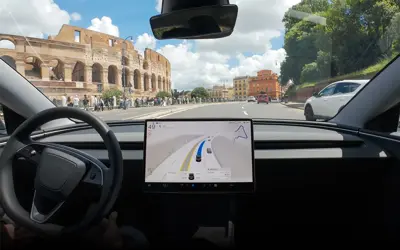
The hardest moments for a self-driving car are not routine straight-line driving or lane changes. They are a pedestrian darting out, or a car ahead braking hard without warning.

The problem is that no one knows when such risks will show up on a real road. Gathering experience means waiting, and meeting those moments in person carries danger.

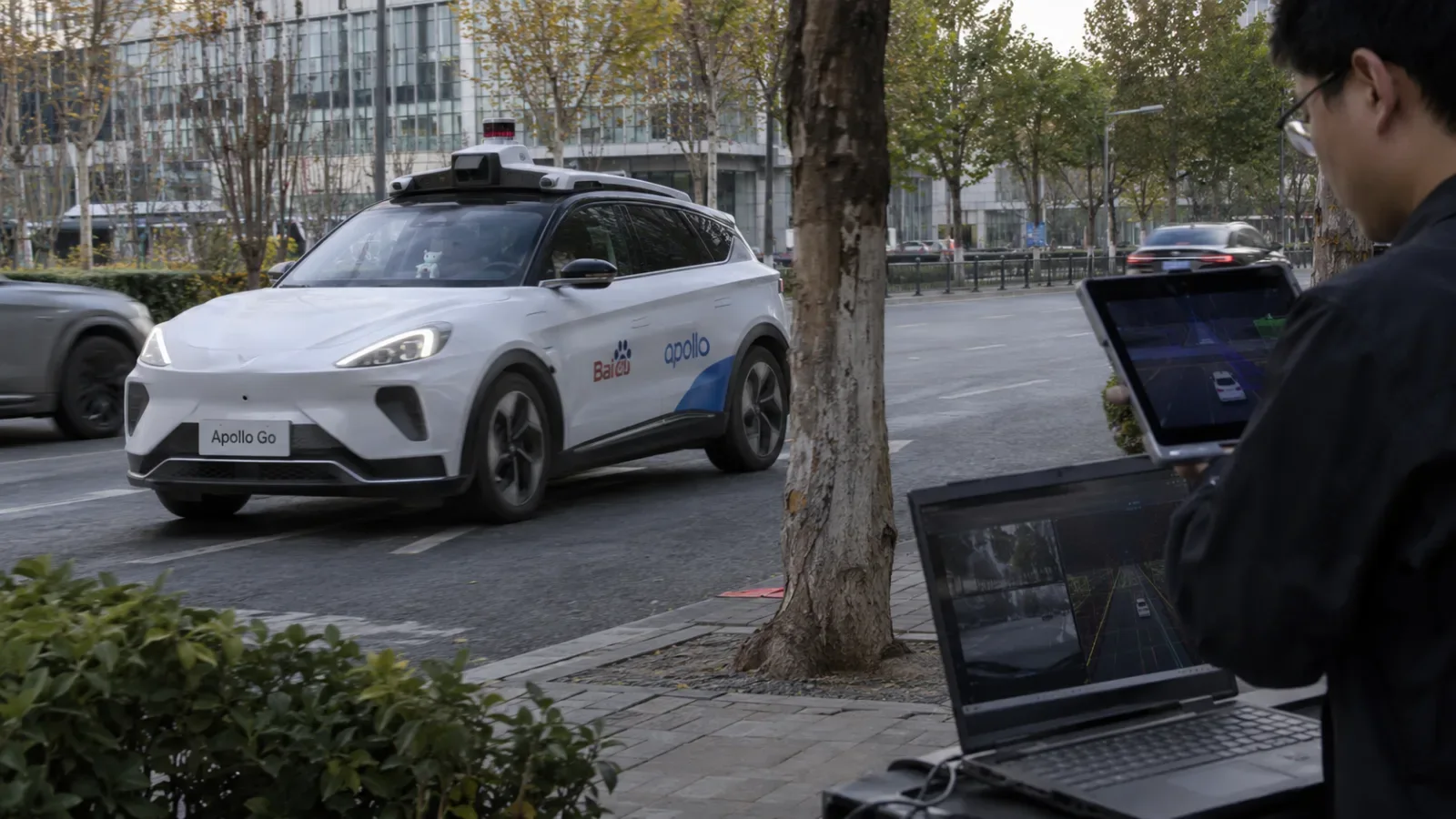
Baidu's Apollo World, announced Nov. 3, targets exactly this. The system builds virtual roads and traffic so that self-driving AI can repeatedly train on rare situations.

The point is not driving longer on the road. It is meeting the risks that must be learned more often.

2. 100,000 km a day: what matters more than the number

100,000 km is the maximum amount of simulated driving data Apollo World can generate in a day.

Baidu likened that scale to about three years of real-world road testing. In a virtual world, a pedestrian stepping out or a sudden stop by the car ahead can be repeated thousands of times.

The system builds environments that resemble real roads, predicts how traffic will change, and generates camera and lidar sensor data. Baidu already uses it to train its robotaxi, Apollo Go.

That does not mean 100,000 virtual km delivers the same learning as 100,000 real km. Practicing the exact situations that lead to real accidents matters more than practicing a million irrelevant risks.

A simulator's strength comes from how closely its training resembles reality, not from how many virtual miles it logs.

3. Tesla is real, Baidu is virtual? It is not that simple

Tesla is known for an approach built on video collected from real vehicles and an end-to-end neural network. Waymo and Baidu, by contrast, combine real driving data with simulation.

But framing this as "Tesla uses only reality, rivals only simulation" misses the point. Real-road experience and virtual training are tools that can be used together rather than substitutes.

Learned from reality: the unpredictable behavior of real drivers and pedestrians, and the complex road environments sensors encounter.

Practiced in simulation: situations that are rare or too dangerous to repeat in reality, and focused training on specific failures.

The question ahead is not just who holds more real-world data. How fast a company can fix, in simulation, a weakness found on real roads, and then confirm the fix on real roads again is what counts.

A good self-driving learning system is not reality versus simulation. It is the ability to connect the two.

4. Investors should look at robotaxi economics, not miles

For investors watching Tesla (TSLA) and Alphabet's Waymo, driving data is a starting point. The real competition begins when that learning ability turns into service expansion.

How much time and money does it take to secure safety when a robotaxi enters a new city? As service expands, how much more does each vehicle earn?

Good simulation can help reduce the burden of experiencing every risk from scratch on real roads. If it works, there is room for faster city expansion and lower training costs.

The process also needs computing power to build virtual environments and train the AI. That is why it can be linked to AI infrastructure companies such as Nvidia.

A robotaxi company's value should be judged less by the distance it has learned than by its ability to operate safely and economically in real cities.

5. Three numbers to watch

  1. Time to enter a new city. The shorter it gets, the stronger the sign that learning and validation carry over to other regions.
  2. Safety and operating cost. Costs must fall while safe operation holds for the economic value of simulation to show.
  3. Profit per vehicle. If per-vehicle earnings do not improve as service grows, better technology does not automatically become a good business.
Does 100,000 km of simulated driving mean the same thing as real-world driving distance?
  • No. It measures the amount of simulated data generated. For investment decisions, what matters more is how accurately it recreates real-world risks and whether it improves actual driving performance.
Is Baidu's announcement immediately bad for Tesla?
  • There is not enough evidence to say so. Companies collect data and train their systems in different ways. The comparison that matters is the safety and scaling efficiency of actual services, not a single technology announcement.
What should Alphabet investors, who own Waymo, check?
  • They should look at how training that combines real-world driving and simulation changes the speed and cost of launching safe service in new cities.
Is this good news for Nvidia too?
  • It is relevant, since generating virtual environments and training AI both require computing power. But the Apollo World announcement alone cannot confirm a direct revenue benefit for Nvidia.

What to watch

Time to enter a new cityIf the time it takes to deploy robotaxis in a new city gets shorter, that shows how well training can be carried over to other regions.
Safety and operating costsWatch whether training and validation costs fall while safe operation is maintained.
Profitability per vehicleAs service expands, whether each vehicle's earnings grow too is the measure of the business case.
Apollo Go resultsWatch whether Baidu discloses numbers showing the results of using Apollo World to train its robotaxis.
Simulated miles matter less than how fast weaknesses found on real roads get fixed in simulation and turned into city expansion and profit.

Insight Times Editorial Desk

More by topic

Starting with this story's topics, then what readers are following now

Investor psychology, decision-making and books on investing

Robotaxi

This story's topic17 storiesSee all →

The Cybercab is not a $30,000 car. Tesla is selling hours, not vehicles

No steering wheel, no pedals. The economics of Tesla's robotaxi turn on how many paid hours a day it runs, not on what it costs to build.

Tech

Tesla's FSD Clears Eight European Countries. The Number That Matters Now Is Paid Conversion

European regulatory barriers for FSD Supervised are falling. But investors who lump supervised software revenue together with the value of driverless robotaxis risk pricing the same news twice.
Tech

Why Tesla Lined Up $30 Billion in Credit It Says It Won't Use This Year

Tesla's 2026 capex is set to nearly triple. The question is less about debt than about when spending on AI, robotaxis, chips and energy turns into cash flow.

Tech

When Will Tesla's Rally Finally Hold? The Case for 2027

The next leg up for Tesla will not come from another product reveal. It will come when self-driving, AI investment and Optimus stop being "future stories" and start showing up as real profit and cash flow. The first real test window is likely 2027.

Investing

Tesla's biggest asset is not the car: when Robotaxi and Optimus stop being options

Tesla's AI value sits in autonomy and humanoids, and both could dwarf car manufacturing. The gap is between a demo and a fleet that earns cash per vehicle.

Tech

Rates Hit 5% Again, But AI Held - Now Wall Street Wants Cash Flow, Not Just GPUs

The Fed raised rates and the 10-year yield broke back above 5%, yet the Nasdaq did not crack. This week's real story is not the end of the AI rally but a change in what the market is grading.

Investing

Tesla Cut Its Capex Guide by $5 Billion. Good News or Bad?

Tesla protected cash, but its growth timetable now carries a question mark. The key issue is not how much it saved but what it pushed back.

Tech

HBM

75 storiesSee all →

Memory stacked next to the GPU.

AI Chip Peak Check: Demand Still Rising, Risk Building in 2027-2029 Supply and Funding

DRAM and NAND contract prices are still climbing and HBM suppliers hold the edge. Power shortages, AI financing costs and simultaneous memory expansion are the risks for later years.

Investing

Has Memory Peaked? Prices Are Cooling, but the Shortage Looks Set to Run to 2028

Price growth has slowed and consumer demand is already breaking. Server and HBM supply remains short, and Micron says more than 75% of its 2027 volume is already committed to customers.

Tech

2027 Isn't the End: Citi's Case for a Memory Supercycle Running to 2031

Citi says the memory shortage timeline is stretching again. If AI shifts from "train once" models to continual learning, HBM, server DRAM and enterprise SSDs could all fall short at the same time.

Tech

AI Chips Haven't Peaked. The Real Risk Sits in 2028 Supply

HBM and server DRAM shortages are now spreading into enterprise SSDs. The question isn't today's strength, it's how much new capacity these prices are pulling in and when it lands.

Investing

2027 Investing Needs Alignment, Not Prediction

A new investing book argues the hard part was never picking the next winner. It's staying aligned with where value and bottlenecks are moving while keeping old human weaknesses in check.

Investor Mind

The Next AI Chip Race Is About How Chips Connect

Applied Materials will lift its stake in Dutch equipment maker BESI from about 9% to 20%. The bet is less about control than about a new way to link chips.

Tech

China's DRAM Push Tests the Memory Supercycle for SK hynix, Samsung and Micron

Memory looks tight through 2027, with oversupply a risk from 2028. Investors in AI chips need to keep the two timelines apart.

Tech

A building that houses servers and networking gear and supplies them with powe…

US AI Data Centers Are Headed for 90GW. Gigawatts Now Matter More Than Dollars

Goldman Sachs expects US data center capacity to grow from 64GW at the end of 2026 to 90GW at the end of 2027. The AI race is moving from buying GPUs to building power plants and transmission lines alongside them.

Tech

AMD Crossed $1 Trillion, and the Market Started Looking at CPUs Again

AMD's stock topped a $1 trillion market cap for the first time. The rally isn't just about being an Nvidia alternative. It reflects a reassessment of AMD as a full-stack AI infrastructure vendor, one that bundles CPUs, GPUs and networking, as AI shifts from chatbots to agents and reignites data center demand for CPUs.</deck> <parameter name="oneline">As AI moves from chatbots to agents, the market has started counting the CPU sitting next to the GPU again.

Tech

Why the White House Swapped "AI" for "Super Intelligence"

Executive Order 14434 renames AI across the federal government without defining a new technology. The real story is about roughly $700 billion in capex, free cash flow and electricity.

Tech

Nvidia's Next Target After GPUs: Controlling What AI Agents Are Allowed to Do

OpenShell and Sentry are not about policing what an AI says. They are about controlling, at the server infrastructure level, which files and APIs an AI can touch, what it can execute, and who can actually pull the plug when something goes wrong.

Tech

Why Nebius Is Keeping Some 2027 AI Capacity Off the Shelf

Nebius mixes long-term contracts, short-term premiums and auctions. Holding back capacity pays only if the servers stay busy, and it is not yet clear the pricing will last.

Tech

DeepSeek's $15 Billion Raise: Model Makers May Feel It Before Nvidia Does

China's DeepSeek is closing a round about twice its original target. For US investors, the question is less the size of the check than where the money goes and whose profits it could erode.

Tech

Why Nvidia Is Happy to Help Make AI Models Nearly Free

Falling model prices can squeeze model makers. For Nvidia, the number that matters is the total volume of tokens generated worldwide and the compute that produces them.

Tech

NVDA

87 storiesSee all →

Amazon Goes After Nvidia's Strongest Moat, and It Is Software, Not GPUs

Amazon's open-source TorchNeuron aims to let existing AI code run on its Trainium chips. The contest comes down to the total cost of AI compute and the return on Amazon's $220 billion in annual capital spending.

Tech

The US-China Summit Didn't Erase Taiwan Risk for Chip Stocks

Washington's Taiwan policy held, but roughly $14 billion in arms sales is still on hold. For AI chip investors, the summit reads less like risk removed and more like a fragile balance extended.

Macro

AI's Next Bottleneck Is Money, Not Chips

Broadcom is lending Anthropic up to $42 billion, and Nvidia wants to build a $500 billion market for loans backed by GPUs. The AI race may turn on what rate buyers pay to borrow.

Tech

ASML Is Discussing 2030 Orders. How Long Can the AI Chip Supercycle Last?

Despite bubble worries, ASML sees equipment shortages through 2028. Investors should watch future production capacity, not just today's orders.

Tech

The Number That Matters More Than How Smart AI Gets

This week's AI models got stronger and cheaper at the same time. The chart long-term investors should watch isn't the weekly benchmark leader, it's the falling cost of finishing a task successfully.

Tech

AI Data Centers' Next Bottleneck: Getting Power From the Grid to the GPU

Securing a gigawatt of power does not mean a gigawatt reaches GPU compute. The next fight in AI infrastructure is happening inside the data center, over how little electricity gets wasted before it reaches the chip.

Tech

AI Raises Prices While It Is Being Built, and Lowers Them Only Once It Is Used

The buildout is pulling in chips, power, land and construction labor all at once, and that pushes prices up. The disinflation shows up later, if the tools actually change how work gets done.

Macro