Palantir's Real Rival Isn't a Smarter AI. It's Europe's Push for Tech Independence
Germany's Helsing has launched an AI agent platform aimed at Palantir's turf. In defense, who controls the data and which systems are already embedded may count for more than model performance.
The 20-second read
1. Does a smarter AI win the defense market?
Picture a military choosing a new AI tool. One product analyzes more information, faster. The other has worked for years inside the military's intelligence networks and command procedures. Which one gets picked?
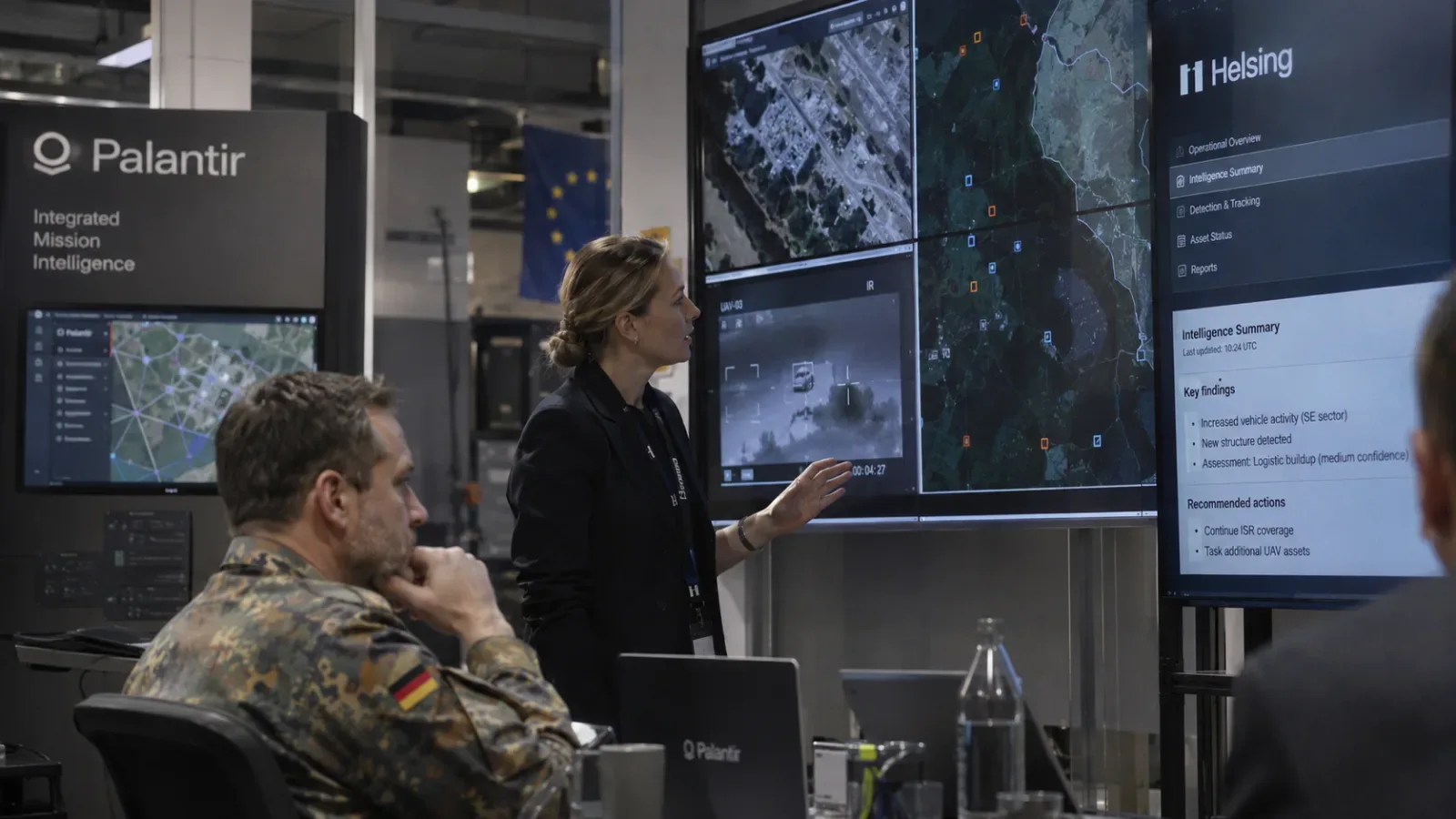
Germany's defense technology company Helsing brought that question into focus on Nov. 11 with Clarity. The software pulls together drones, satellites, military reports and open-source information to identify military assets and propose responses.
Hundreds of specialized AI agents cross-check different streams of information. The system is designed to show how confident it is in a judgment and the evidence behind it. Human operators still approve any actual strike.
2. Europe wants more than performance
Defense AI comes with purchasing conditions that ordinary enterprise software does not. One question is: which country's corporate systems will be trusted with the military's sensitive information?
That is data sovereignty. Add the political risk and contractual constraints that come with long-term reliance on a single US supplier. Performance competition alone does not explain why Europe is looking for its own alternatives.
Helsing points to its experience supplying defense systems to Ukraine. Whether Clarity has already been adopted by military customers, and when it might be operational, has not been disclosed. Even so, the announcement suggests Europe may have more defense AI suppliers to choose from.
3. So what is Palantir's real moat?
Palantir's strength does not rest on a single model. Maven is embedded in the work of the US Department of Defense and NATO, and has been refined through real operations.
Defense software is hard to swap by deleting one app and installing another. Data connections, military workflows, security systems and the trust of the people running them are all tangled together.
| Challenger | Incumbent |
|---|---|
| Helsing, Clarity | Palantir, Maven |
| Integrates varied military intelligence and analyzes it with AI agents. An alternative that answers Europe's demand for technological sovereignty. | Operating experience built up at the Pentagon and NATO. Its assets are already-connected data, workflows and customer trust. |
That gap is the switching cost. Even if a rival offers better features, replacing an existing system forces an organization to take on new integration work and validation.
4. What this competition means for PLTR investors
Helsing's arrival sends Palantir two different signals. In new European defense business, local companies that lead with technological sovereignty could grow more competitive. In existing work with the US and its allies, the operating base Palantir has built is unlikely to disappear easily.
So the useful question for investors is not where the new product ranks on AI performance. It is how much more deeply Palantir connects to existing customers' work, and why it is chosen or shut out in procurement contests in new countries.
Two questions for reading defense AI competition
- New contract competition: Whose technology can a country trust and control?
- Keeping existing contracts: Is there reason enough to replace data and workflows already in place?
This is not only a Palantir story. US big tech firms supplying AI to foreign governments, public agencies and strategic industries meet the same question. Technical excellence and a country's demand for technological independence do not always point the same way.
- It is military AI software announced on November 11 by Helsing, a German defense technology company.
- It pulls together drone and satellite data, military reports and open-source information to identify military assets and suggest responses.
- A human operator, not the software, approves any actual strike.
- That has not been confirmed.
- Whether any military customer has adopted it, and when it might actually be used in operations, has not been made public.
- Performance alone does not explain it.
- There is a data sovereignty question: which country's company should be trusted with sensitive military information.
- Political risk and contractual constraints from long dependence on a particular US supplier are also cited as reasons.
- In the article's view, no single model is at the center of its strength.
- Maven was refined through operational use in the work of the US Department of Defense and NATO.
- Already connected data, work procedures and customer trust can be seen as larger assets.
- Even if a rival offers better features, replacing an existing system requires new integration work and validation.
- That burden is likely to work in favor of keeping existing customers.
What to watch
Insight Times Editorial Desk