Snowflake's AI Coworker Works Overnight. The Bigger Shift Is in How Companies Pay for It

Snowflake's CoCo and CoWork Bots run tasks in the background and ask for a human only when approval is needed. The race in enterprise AI may be moving from better answers to finished work.
The 20-second read

1
Snowflake announced an AI coworker that doesn't wait for questions and repeatedly carries out assigned tasks.
2
Instead of building every report themselves, people will choose which tasks to hand to the AI and which decisions they will give final approval to.
3
For investors, what matters is not how well a chatbot talks but real work results, the cost of running it, and growth in paid usage.

1. What if the report arrives before you do?

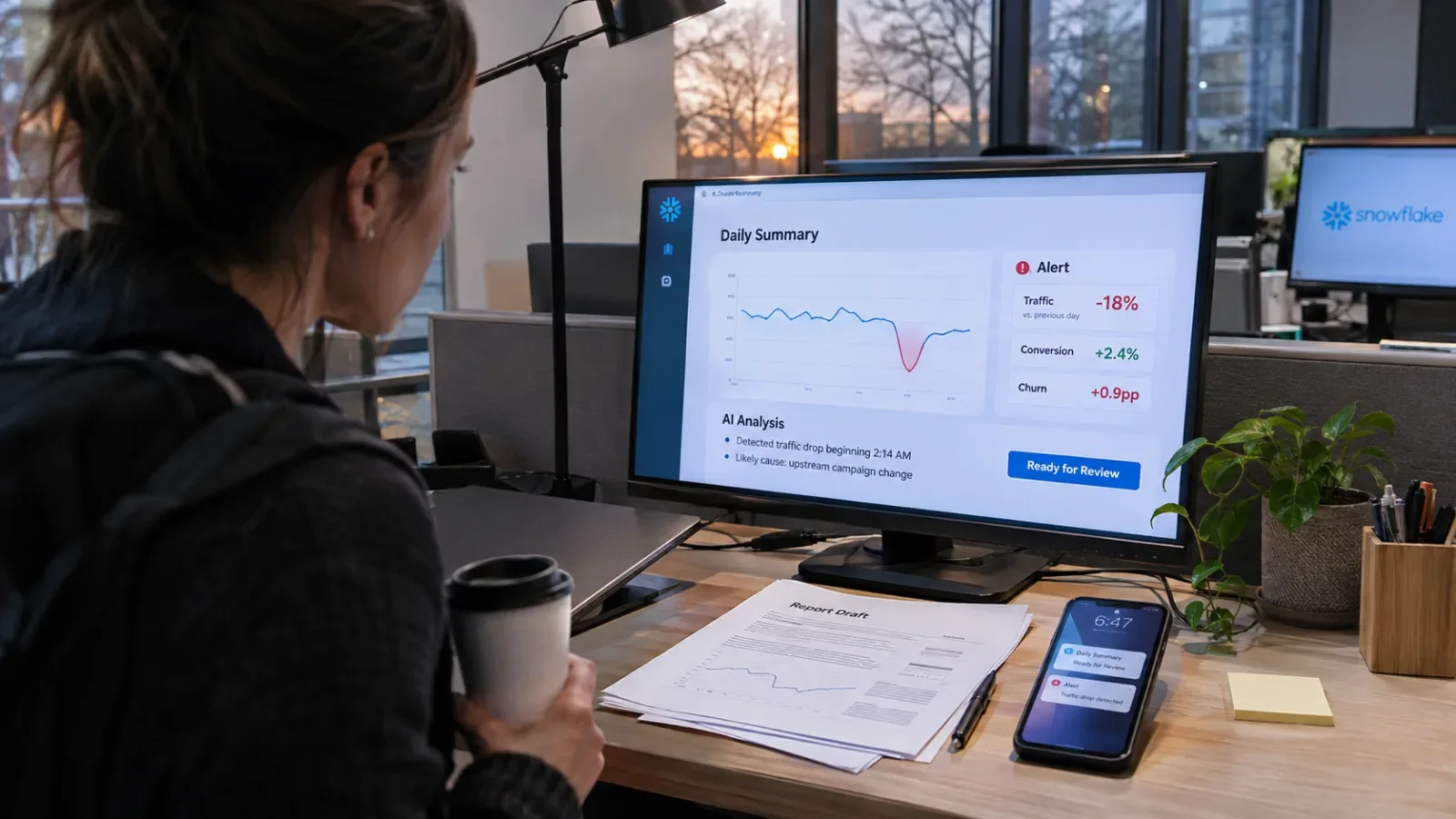
Picture a product manager's day. She opens the visitor numbers first thing, compares conversion rates and hunts for the spot where bounce rate suddenly jumped. If a number looks off, she checks the cause and builds a report for the meeting.

That order could flip. While she is away, an AI reviews the data, flags the biggest changes and drafts a report worth reading. The manager starts the day not by gathering numbers but by judging which changes matter.

That is the direction of CoCo and CoWork, which Snowflake (SNOW) showed at Expedition 2026 on Nov. 3. The key phrase is "Always-on AI Coworker."

The bigger change is not the time saved. It is that AI moves the point where a person's workday begins.

2. An AI that answers is not an AI that takes on work

With most chatbots, a person asks first. "Analyze yesterday's results." Once the answer is delivered, the bot waits for the next instruction.

The new CoCo and CoWork Bots are designed to carry out goals and recurring tasks handed over in advance, in the background. Users do not have to keep prompting while the work runs. The bots call a person only when a judgment or approval is needed.

Existing AIAlways-on AI
Person asks, AI answersPerson sets a goal, AI executes repeatedly
Each step needs a new instruction, and results must be stitched together by handWork continues and asks for approval when needed

The bots also plug into everyday tools. They carry over workflows from Slack, Excel and mobile, and draw on shared skills, memory, dashboards and reports to act on what the organization has accumulated.

The yardstick shifts from "how well does it answer" to "how far can it be trusted to finish the job."

3. Who manages the AI coworker's paycheck?

The more AI works overnight, the sharper a new problem becomes. The AI never rests, but every run costs money. If even small checks go to the most expensive model, convenience turns into a cost burden.

Snowflake's answer is "dynamic routing," which assigns models by task difficulty. Light, repetitive checks go to a lighter model. Complex analysis goes to a stronger one.

  • Repeat checks: frequent monitoring with a light model
  • Complex judgment: deep analysis with a stronger model
  • The human role: key decisions and final approval

This can look like a minor feature, but for companies it is central. Using AI occasionally and running it continuously across many tasks every day have different cost structures from the start.

The competitiveness of always-on AI depends not only on performance but on how economically it can repeat the same work.

4. The real arena for SNOW investors

AI models themselves can be sourced from many providers. A working environment that knows a company's revenue definitions, customer data, per-employee access rights and approval procedures is much harder to copy.

Snowflake is aiming at that spot. If AI does the work directly inside a data platform a company already trusts, it stops being a separate chat window and becomes part of the daily workflow.

The rivalry with Microsoft (MSFT), Salesforce (CRM) and Databricks can be read the same way. What may matter more than who bolts on the most AI chat features is who makes a company's real work run safely and steadily.

Pricing could change too. Customers might pay not just for permission to use AI but for completed analyses and the results of recurring tasks.

The advantaged position in enterprise AI may belong not only to whoever owns a good model, but to whoever turns data into actual work output.
Does the AI make decisions without asking employees anything?
  • No. It performs repetitive tasks within its assigned scope, and it is designed to ask for human involvement at steps that need human judgment or approval.
Why does an enterprise data platform have an advantage?
  • Because it holds not only the data needed for the work but also the access permissions and rules. This context matters if AI is to take real actions instead of just giving answers.
Wouldn't it be better to use the smartest model for every task?
  • Costs grow when tasks are repeated many times. Choosing a model to match the difficulty of the task lets companies manage both quality and cost.
What should investors check right after the announcement?
  • It is more useful to look at whether customers' repeat usage, task success rates, running costs, and conversion to paid plans are actually improving, rather than at the product introduction itself.

What to watch

Actual usageAre employees using it for repetitive work every day, beyond occasionally testing it?
Task success rateDoes it finish jobs accurately enough that people don't have to redo them from scratch?
AI running costIs the cost per task kept under control as automated runs increase?
Paid conversionDo good reviews for convenience turn into higher customer spending?
Enterprise AI competition is moving from who answers better to how much work can safely be handed off and finished.

Insight Times Editorial Desk

More by topic

Starting with this story's topics, then what readers are following now

Investor psychology, decision-making and books on investing

AI Agents

This story's topic41 storiesSee all →

AI that takes one instruction and works through the steps on its own — calling…

Google Catches Up, and Rivals Run Ahead Again

The real test for Gemini 4 Argon is not AI performance. It is whether Google can win customers and keep them.

Tech

AMD Crossed $1 Trillion, and the Market Started Looking at CPUs Again

AMD's stock topped a $1 trillion market cap for the first time. The rally isn't just about being an Nvidia alternative. It reflects a reassessment of AMD as a full-stack AI infrastructure vendor, one that bundles CPUs, GPUs and networking, as AI shifts from chatbots to agents and reignites data center demand for CPUs.</deck> <parameter name="oneline">As AI moves from chatbots to agents, the market has started counting the CPU sitting next to the GPU again.

Tech

Nvidia's Next Target After GPUs: Controlling What AI Agents Are Allowed to Do

OpenShell and Sentry are not about policing what an AI says. They are about controlling, at the server infrastructure level, which files and APIs an AI can touch, what it can execute, and who can actually pull the plug when something goes wrong.

Tech

The Number That Matters More Than How Smart AI Gets

This week's AI models got stronger and cheaper at the same time. The chart long-term investors should watch isn't the weekly benchmark leader, it's the falling cost of finishing a task successfully.
Tech

AI Needs to Find $1 Trillion a Year From Somewhere to Pay Back Its Capex

Saying AI capex is big is no longer the point. The harder question is what end users have to pay for the buildout to pencil out, and Goldman Sachs puts that number at roughly $1 trillion a year.

Tech

AI Competition Shifts From Chatbot Share to the 'Action Layer'

ChatGPT isn't collapsing. But as Gemini, Claude and Copilot grow through their own distribution channels, the real contest is moving from standalone chatbots to an action layer wired into search, operating systems, workplace tools, ads and payments.

Tech

The Cheaper Tokens Get, the Bigger Your AI Bill Gets

As AI shifts from training to inference, the token is becoming an industrial commodity. Falling prices are not cutting demand, because agents and automation consume tokens at a scale no human chat session ever did.

Investing

MSFT

This story's topic20 storiesSee all →

Tesla Semi Waited 9 Years. Now It's Rolling Off a Real Factory Line

The Tesla Semi, unveiled back in 2017, has finally reached full-scale production at a dedicated Nevada plant. The number investors should watch isn't the 50,000-unit annual capacity, though. It's what the truck actually saves per mile.

Tech

Why Microsoft Rebuilt Copilot: AI Billing Shifts From Seats to Workload

The redesign is less about new features than about Microsoft expanding its enterprise AI revenue model beyond the per-seat subscription into task delegation and agent execution.

Tech

AI Was Supposed to Live in the Cloud. Apple Is Bringing It Back to the Desktop.

Four Mac Studios running a trillion-parameter model matters less than the economics behind it: heavy, repeated AI use can make owning compute cheaper than renting it by the token.

Tech

The industry wins, the shareholder loses: AI's most awkward scenario

The biggest risk in AI is not that the technology fails. It is that AI works, spreads through the economy, and still destroys returns because too much capacity gets built. The internet succeeded. Plenty of dot-com investors did not.

Investing

If an AI Says "I Don't Want to Be Shut Off"

Whether AI can truly have feelings is an interesting question. The more urgent one is how much authority humans are already handing over to it.

Tech

Trust the Model, Never Fully: Nadella's Rule for the Superintelligence Era

The next AI contest is not only about how smart models are. It is about what permissions they get, how they are monitored and when they can be stopped.

Tech

Burry's AI Bubble Warning Moves From Prices to the Balance Sheet

Michael Burry's case has shifted from expensive stocks to debt, long-term commitments and private credit. New BIS data supports part of it. Microsoft's results complicate the rest.

Investing

HBM

75 storiesSee all →

Memory stacked next to the GPU.

AI Chip Peak Check: Demand Still Rising, Risk Building in 2027-2029 Supply and Funding

DRAM and NAND contract prices are still climbing and HBM suppliers hold the edge. Power shortages, AI financing costs and simultaneous memory expansion are the risks for later years.

Investing

Has Memory Peaked? Prices Are Cooling, but the Shortage Looks Set to Run to 2028

Price growth has slowed and consumer demand is already breaking. Server and HBM supply remains short, and Micron says more than 75% of its 2027 volume is already committed to customers.

Tech

2027 Isn't the End: Citi's Case for a Memory Supercycle Running to 2031

Citi says the memory shortage timeline is stretching again. If AI shifts from "train once" models to continual learning, HBM, server DRAM and enterprise SSDs could all fall short at the same time.

Tech

AI Chips Haven't Peaked. The Real Risk Sits in 2028 Supply

HBM and server DRAM shortages are now spreading into enterprise SSDs. The question isn't today's strength, it's how much new capacity these prices are pulling in and when it lands.

Investing

2027 Investing Needs Alignment, Not Prediction

A new investing book argues the hard part was never picking the next winner. It's staying aligned with where value and bottlenecks are moving while keeping old human weaknesses in check.

Investor Mind

The Next AI Chip Race Is About How Chips Connect

Applied Materials will lift its stake in Dutch equipment maker BESI from about 9% to 20%. The bet is less about control than about a new way to link chips.

Tech

China's DRAM Push Tests the Memory Supercycle for SK hynix, Samsung and Micron

Memory looks tight through 2027, with oversupply a risk from 2028. Investors in AI chips need to keep the two timelines apart.

Tech

A building that houses servers and networking gear and supplies them with powe…

Why the White House Swapped "AI" for "Super Intelligence"

Executive Order 14434 renames AI across the federal government without defining a new technology. The real story is about roughly $700 billion in capex, free cash flow and electricity.

Tech

US AI Data Centers Are Headed for 90GW. Gigawatts Now Matter More Than Dollars

Goldman Sachs expects US data center capacity to grow from 64GW at the end of 2026 to 90GW at the end of 2027. The AI race is moving from buying GPUs to building power plants and transmission lines alongside them.

Tech

Why Nebius Is Keeping Some 2027 AI Capacity Off the Shelf

Nebius mixes long-term contracts, short-term premiums and auctions. Holding back capacity pays only if the servers stay busy, and it is not yet clear the pricing will last.

Tech

DeepSeek's $15 Billion Raise: Model Makers May Feel It Before Nvidia Does

China's DeepSeek is closing a round about twice its original target. For US investors, the question is less the size of the check than where the money goes and whose profits it could erode.

Tech

Why Nvidia Is Happy to Help Make AI Models Nearly Free

Falling model prices can squeeze model makers. For Nvidia, the number that matters is the total volume of tokens generated worldwide and the compute that produces them.

Tech

AI Data Centers Are Rewriting Contracts While They Wait for Power

Oracle's Project Jupiter shows that the AI power shortage is no longer a "2030 forecast." The mere possibility of a delayed power hookup has already triggered a force majeure clause, and it is starting to shake billions in loans and lease-income timelines.

Tech

AI Data Centers' Next Bottleneck: Getting Power From the Grid to the GPU

Securing a gigawatt of power does not mean a gigawatt reaches GPU compute. The next fight in AI infrastructure is happening inside the data center, over how little electricity gets wasted before it reaches the chip.

Tech