Musk Walks Colossus 2 at Midnight and Reveals a Four-Building AI Plan

Elon Musk detailed how Colossus 2 in Memphis splits training and inference across four buildings. The dates he gave are targets, not confirmation that the sites are running.
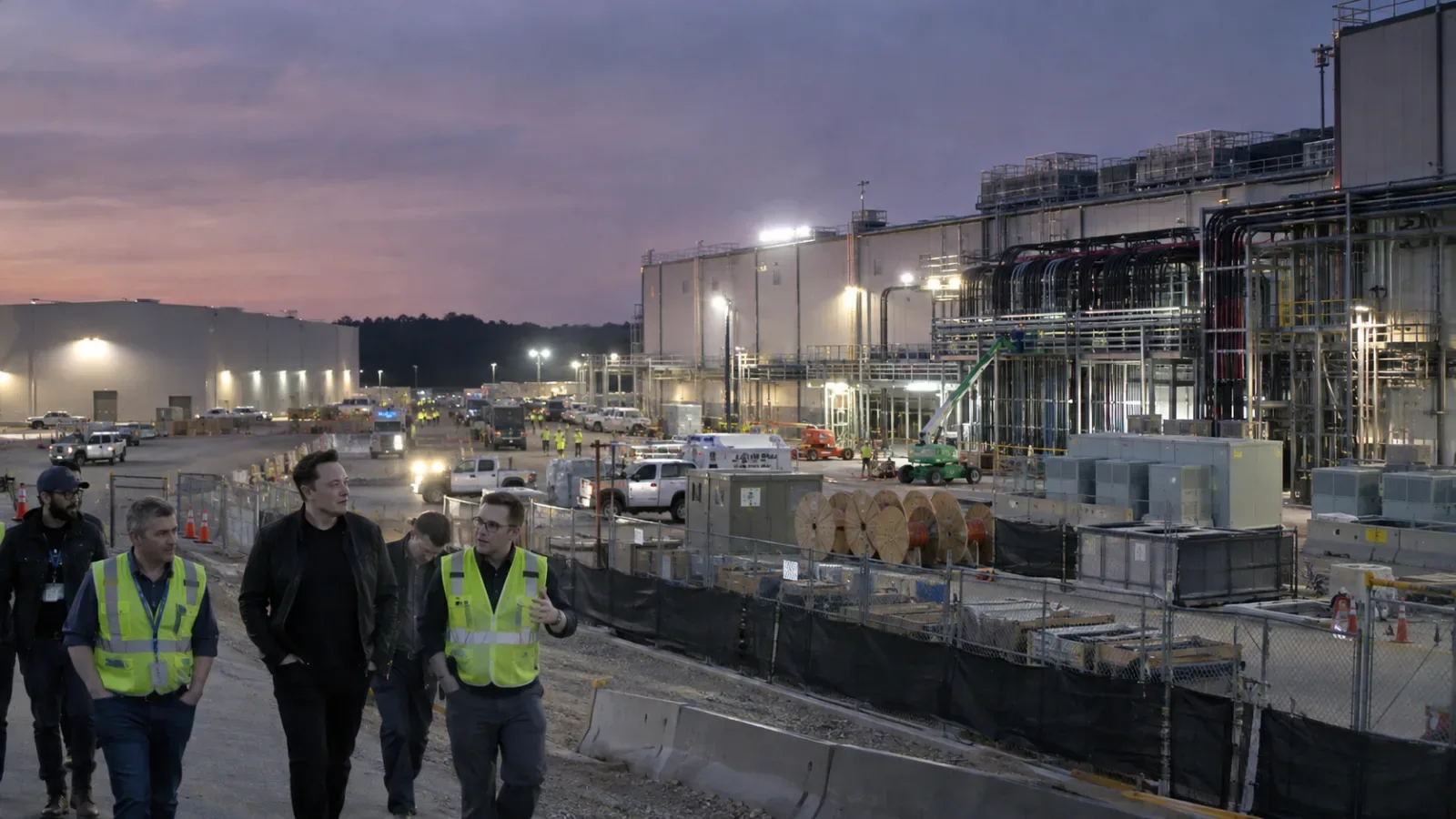
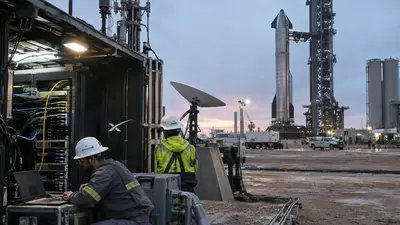
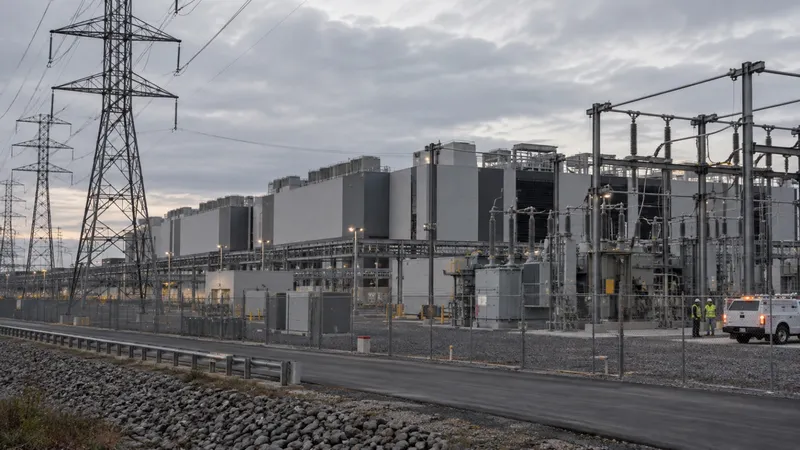
Elon Musk and staff in safety vests walking past Colossus 2 data center construction site at dusk, Memphis
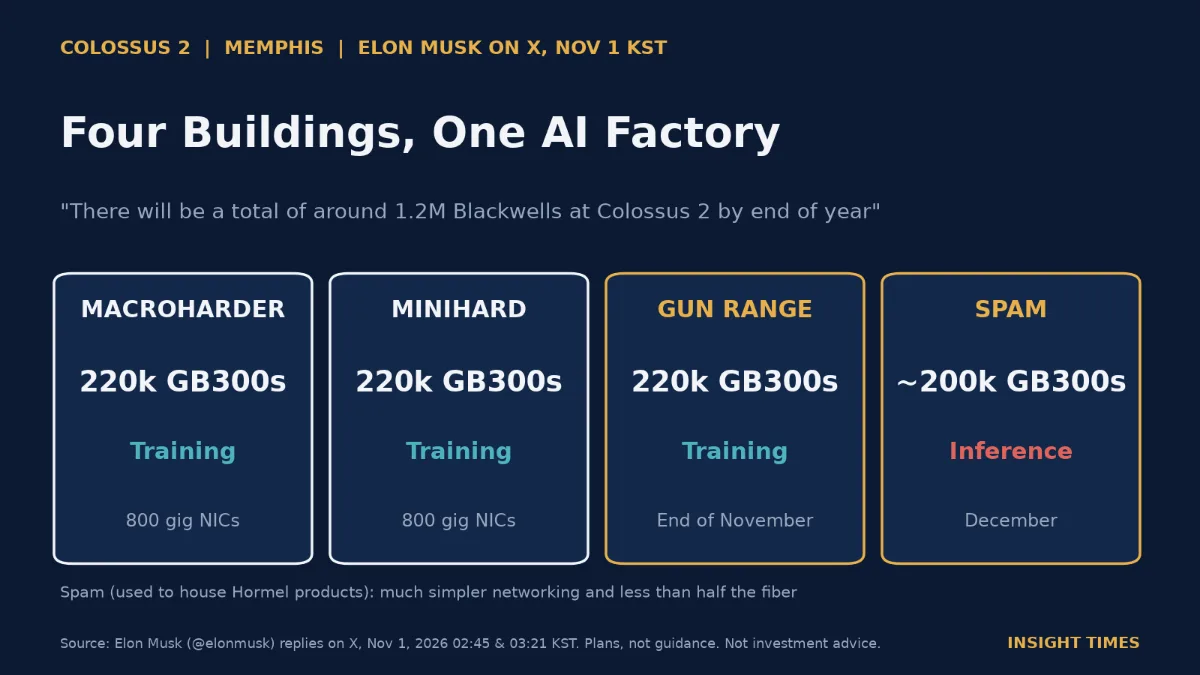
Infographic: Colossus 2 in Memphis, per Elon Musk X replies on Nov 1, 2026. Four building cards: Macroharder 220k GB300s for training with 800 gig NICs; Minihard 220k GB300s for training with 800 gig NICs; Gun Range 220k GB300s for training, tracking to be operational by end of November; Spam ~200k GB300s for inference, December. Note: Spam, which used to house Hormel products, needs much simpler networking and less than half the fiber. Headline quote: There will be a total of around 1.2M Blackwells at Colossus 2 by end of year. Plans and outlook, not official guidance. Not investment advice.

1. A midnight site check starts the Colossus 2 story

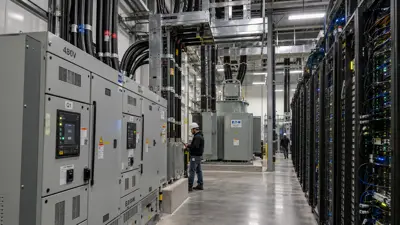
Elon Musk laid out the building-by-building makeup of Colossus 2 in an X reply early Sunday, Nov. 1. He said he walked the entire site twice, around midnight and again the next morning. He also said the SpaceX team and the contractors are making good progress.

The story is not a vague expansion pledge. It is a site plan that spells out which GPUs go in which building, what each will train, and where inference will run. But the start dates Musk gave are targets, not confirmation that the work is done.

2. From Macroharder to Spam: the role of each building

"Macroharder" reads like a parody of Microsoft's name. "Spam" is a building that once stored Hormel products. The names are playful, but the roles are clear.

BuildingGPUsUseNetworkingTimingSource
Macroharder220k GB300sTraining800 gig NICsNot givenMusk directly
Minihard220k GB300sTraining800 gig NICsNot givenMusk directly
Gun Range220k GB300sTrainingSame setup as the earlier training buildingsTargeting operational by end of NovemberMusk directly
Spam~200k GB300sInferenceSimpler than training, less than half the fiberTargeting DecemberMusk directly

In a separate post, Herbert Ong described Macrohard as roughly 550,000 GB200s, Macroharder as about 810,000 square feet and Minihard as about 312,000 square feet. He also mentioned a land swap for a fifth data center, a warehouse that could become a sixth facility, and 444 acres at Starbase in Brownsville. These are Ong's descriptions, not building-level figures Musk confirmed himself.

3. Why a model that learns and a model that answers need different networks

Training is closer to an AI reading its textbooks and learning how to solve problems. Inference is the already-trained AI answering a user's question. That difference reaches all the way down to how a data center is wired.

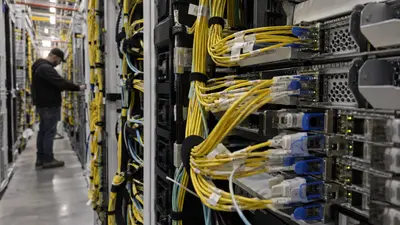
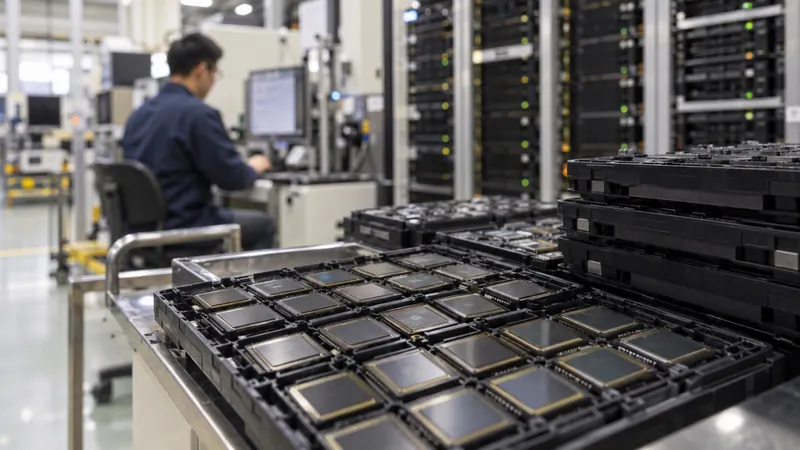
In training, many GPUs must trade results constantly. An 800 gig NIC is the high-speed network interface card that handles that traffic. Inference, depending on how the work is run, can reduce the communication load between GPUs. Musk said Spam's networking is far simpler and uses less than half the fiber of the training buildings. That is a design feature of Spam as he described it, not a rule for every inference system.

4. About 860,000 GB300s versus 1.2 million Blackwells: why the numbers differ

X Freeze added up the GB300s across the four buildings and got about 860,000. That total is X Freeze's arithmetic, not a figure Musk gave. Sawyer Merritt grouped the GPUs in the two new buildings, Gun Range and Spam, at about 420,000 and estimated their value at more than $35 billion. That cost estimate is not Musk's statement.

At 3:21 a.m. KST Sunday, Musk replied that around 1.2 million Blackwells would be at Colossus 2 in total by year-end. The 860,000 figure is the GB300 sum for four specific buildings. The 1.2 million figure refers to all Blackwells at Colossus 2. Because the scope and classification differ, the two numbers cannot be compared on the same basis, and the gap cannot be read as unconfirmed capacity. Unlike an earlier article on SpaceX's revenue outlook, this one focuses on building-level deployment and whether the sites are running.

5. The reaction on X, and Musk's joke

After Musk's building-by-building post, Merritt summarized the new facilities, and X Freeze totaled the GPUs across the four buildings. Musk then joked that he hoped Spam would not produce too much spam. Next came his year-end target of about 1.2 million Blackwells.

The engagement figures below were collected on the morning of Sunday, Nov. 1 (KST). They are not live numbers, and each post had a different exposure window.

Musk postViewsLikesRepostsQuotesRepliesBookmarks
Building makeup651,3696,766513205367583
Spam joke140,3703,1261141527969
Year-end target414,2774,912332143291344

6. Three timelines long-term investors can check

Publishing GPU placement and roles by building lets observers watch how AI compute buildouts are executed. But an X reply is not official company guidance or a filing. For investors who build positions gradually over the long term, it is more reasonable to look for a link between actual operations and business results than to get excited.

Installing GPUs, running them reliably, and turning that compute into revenue and cash flow are separate stages.

Colossus 2 is built from three training buildings and one inference building, but the start dates are still only Musk's targets.

Insight Times Editorial Desk

More by topic

Starting with this story's topics, then what readers are following now

Investor psychology, decision-making and books on investing

Data Centers

This story's topic86 storiesSee all →

A building that houses servers and networking gear and supplies them with powe…

US AI Data Centers Are Headed for 90GW. Gigawatts Now Matter More Than Dollars

Goldman Sachs expects US data center capacity to grow from 64GW at the end of 2026 to 90GW at the end of 2027. The AI race is moving from buying GPUs to building power plants and transmission lines alongside them.

Tech

Why Nvidia Is Happy to Help Make AI Models Nearly Free

Falling model prices can squeeze model makers. For Nvidia, the number that matters is the total volume of tokens generated worldwide and the compute that produces them.

Tech

Tesla Energy's 13.7GWh Paradox: Expectations Ran Faster Than Deployments

Q2 deployments recovered but margins collapsed. Q3 set a record for deployments and still missed estimates. The issue is not the size of AI power demand but how fast it converts into Tesla revenue and profit.

Tech

Why the White House Swapped "AI" for "Super Intelligence"

Executive Order 14434 renames AI across the federal government without defining a new technology. The real story is about roughly $700 billion in capex, free cash flow and electricity.

Tech

Nvidia's Next Target After GPUs: Controlling What AI Agents Are Allowed to Do

OpenShell and Sentry are not about policing what an AI says. They are about controlling, at the server infrastructure level, which files and APIs an AI can touch, what it can execute, and who can actually pull the plug when something goes wrong.

Tech

2027 Investing Needs Alignment, Not Prediction

A new investing book argues the hard part was never picking the next winner. It's staying aligned with where value and bottlenecks are moving while keeping old human weaknesses in check.

Investor Mind

AMD Crossed $1 Trillion, and the Market Started Looking at CPUs Again

AMD's stock topped a $1 trillion market cap for the first time. The rally isn't just about being an Nvidia alternative. It reflects a reassessment of AMD as a full-stack AI infrastructure vendor, one that bundles CPUs, GPUs and networking, as AI shifts from chatbots to agents and reignites data center demand for CPUs.</deck> <parameter name="oneline">As AI moves from chatbots to agents, the market has started counting the CPU sitting next to the GPU again.

Tech

GPU

This story's topic60 storiesSee all →

A chip built to draw graphics, whose ability to run thousands of identical cal…

Amazon Goes After Nvidia's Strongest Moat, and It Is Software, Not GPUs

Amazon's open-source TorchNeuron aims to let existing AI code run on its Trainium chips. The contest comes down to the total cost of AI compute and the return on Amazon's $220 billion in annual capital spending.

Tech

The US-China Summit Didn't Erase Taiwan Risk for Chip Stocks
Washington's Taiwan policy held, but roughly $14 billion in arms sales is still on hold. For AI chip investors, the summit reads less like risk removed and more like a fragile balance extended.

Macro

AI's Next Bottleneck Is Money, Not Chips

Broadcom is lending Anthropic up to $42 billion, and Nvidia wants to build a $500 billion market for loans backed by GPUs. The AI race may turn on what rate buyers pay to borrow.

Tech

Nvidia Put $2 Billion Into Lumentum. Optics May Be the Next Bottleneck, but the Stock Has Already Run

Optical networking is emerging as the next constraint on AI data centers. Investors need to separate the industry's growth potential from the price they are already paying for it.

Tech

The Next AI Chip Race Is About How Chips Connect

Applied Materials will lift its stake in Dutch equipment maker BESI from about 9% to 20%. The bet is less about control than about a new way to link chips.

Tech

Nvidia's $500 Billion Experiment: Wall Street Asks Who Backs the GPU, Not Just the Chip

The real issue in Nvidia's financing platform is not chip sales. It is how far Wall Street will trust GPU resale prices and rental income three to four years out.

Tech

AI Data Centers' Next Bottleneck: Getting Power From the Grid to the GPU

Securing a gigawatt of power does not mean a gigawatt reaches GPU compute. The next fight in AI infrastructure is happening inside the data center, over how little electricity gets wasted before it reaches the chip.

Tech

HBM

75 storiesSee all →

Memory stacked next to the GPU.

Has Memory Peaked? Prices Are Cooling, but the Shortage Looks Set to Run to 2028

Price growth has slowed and consumer demand is already breaking. Server and HBM supply remains short, and Micron says more than 75% of its 2027 volume is already committed to customers.

Tech

AI Chip Peak Check: Demand Still Rising, Risk Building in 2027-2029 Supply and Funding

DRAM and NAND contract prices are still climbing and HBM suppliers hold the edge. Power shortages, AI financing costs and simultaneous memory expansion are the risks for later years.

Investing

AI Chips Haven't Peaked. The Real Risk Sits in 2028 Supply

HBM and server DRAM shortages are now spreading into enterprise SSDs. The question isn't today's strength, it's how much new capacity these prices are pulling in and when it lands.

Investing

Memory Chip Supercycle: Not at Peak Yet, But 5 of 6 Warning Signs Are Flashing

Memory prices are still climbing, but the pace is slowing and PC and smartphone demand is starting to crack under the weight of higher chip costs. This looks less like a price peak and more like a profit plateau building toward the next supply cycle.

Investing

2027 Isn't the End: Citi's Case for a Memory Supercycle Running to 2031

Citi says the memory shortage timeline is stretching again. If AI shifts from "train once" models to continual learning, HBM, server DRAM and enterprise SSDs could all fall short at the same time.

Tech

Samsung, SK Hynix Sold Off on AI Fears. The Orders Haven't Followed Yet

The selloff reflects a market recalculating AI capex speed and memory earnings expectations, not confirmed cancellations. So far, the data show a gap between fear and reality.

Investing

How Far Can China Push DRAM Without EUV

CXMT says it has shrunk DRAM features to 11.95nm using quadruple patterning instead of EUV lithography. The real question is not whether China caught up, but how much more it now costs China to get there.

Tech

NVDA

83 storiesSee all →

ASML Is Discussing 2030 Orders. How Long Can the AI Chip Supercycle Last?

Despite bubble worries, ASML sees equipment shortages through 2028. Investors should watch future production capacity, not just today's orders.

Tech

The AI Bubble Question Has Changed: By Late 2026, It's ROIC Over GPUs

There is no sign yet that AI investment is slowing. If anything, hyperscaler spending forecasts keep climbing. But as the scale of that capital has grown, the market's question has shifted from "is AI growing" to "when, and how much, does this capital come back as cash."

Tech

The Question Markets Asked This Week: Who Controls the AI Bottleneck, Not Who Owns AI

The Fed hiked again and the 10-year topped 5 percent, but the center of the AI trade held. The market is no longer asking whether AI is growing, it is asking who controls memory, power and capital.

Tech

TSMC's August number that matters is not 53%. It is September's threshold

TSMC posted its first month above NT$500 billion. The useful reading is not the growth rate but what September revenue has to be to hit the top of third-quarter guidance, and whether AI demand is still alive on the factory floor.

Tech

The Cheaper Tokens Get, the Bigger Your AI Bill Gets

As AI shifts from training to inference, the token is becoming an industrial commodity. Falling prices are not cutting demand, because agents and automation consume tokens at a scale no human chat session ever did.

Investing

What Jensen Huang sold at the G20 was not GPUs. It was national infrastructure

Nvidia's message is that AI should be laid down like electricity, roads and the internet. After the hyperscalers, the buyers are governments, telcos, regional clouds and industrial data centers.

Tech

Before Robots Sell, Chips Sell First: Following the Money in the Humanoid Race

Billions of dollars are moving before humanoid robots reach mass sales. Compute suppliers may see revenue first, but that does not guarantee stock returns.

Tech